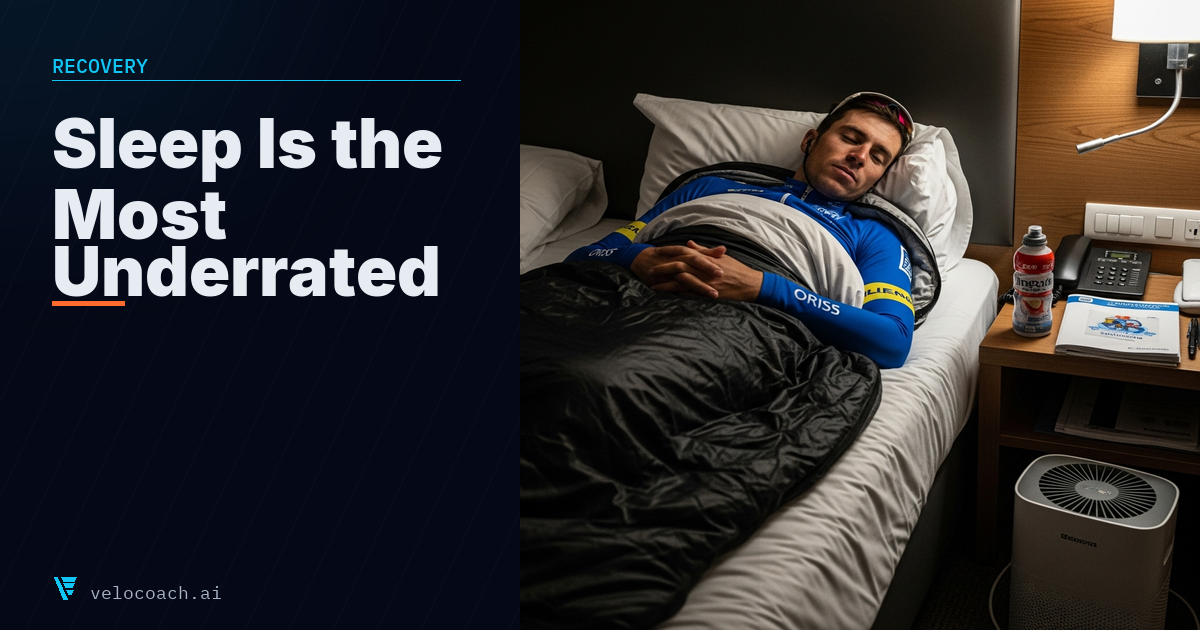
Sleep Is the Best Legal Performance Enhancer You're Not Taking Seriously
Athletes obsess over marginal gains. Lighter wheels, aero helmets, specific tyre pressures, legal supplements. They will spend hundreds of pounds chasing a one or two percent performance improvement.
Meanwhile, most of them are sleeping six hours a night and leaving a fifteen percent performance gain on the table.
That is not an exaggeration. Research consistently shows that consistently achieving seven to nine hours of quality sleep can improve athletic performance by up to 15% compared to a baseline of chronically short sleep. No legal substance, no equipment upgrade, no training protocol produces returns that large.
Sleep is where training adaptations are consolidated. The ride was the stimulus. Sleep is where the body responds.
What Happens During Sleep
While you are unconscious, your body is not idle. Growth hormone is released in pulses, primarily during slow-wave (deep) sleep. This hormone drives tissue repair, muscle protein synthesis, and the physiological adaptations that result from training. Without sufficient sleep, this process is curtailed.
Cortisol, the primary stress hormone, drops during sleep and rebuilds overnight. Chronically short sleep keeps cortisol elevated during hours when it should be recovering, which impairs muscle repair and increases catabolic (muscle-breaking) processes.
Glycogen resynthesis, the replenishment of muscle fuel stores, is more efficient during sleep than during waking rest. If you do a hard session, sleep is not just recovery. It is active refuelling.
The immune system also depends heavily on sleep. Training suppresses immunity transiently after hard sessions, a normal response. Sleep is when immunity is restored. Athletes who chronically undersleep get sick more often, and illness disrupts training far more than any single missed night of sleep.
What the Research Shows
A 2025 study tracking cyclists during a tour-level stage race found that professional riders needed an average of 8.2 hours of sleep to feel adequately recovered, but were only achieving approximately 7 hours per night. The cumulative deficit over a three-week race contributed to declining power outputs in the final days.
Research published in 2025 on the effects of sleep deprivation found that 25 hours without sleep impaired moderate-intensity cycling performance significantly, primarily through increased perceived effort. Critically, one full night of recovery sleep was sufficient to restore performance to rested baseline levels for single-night deprivation. The implication for cyclists is that occasional short nights are recoverable. Chronic sleep restriction is not.
Research from Eindhoven University of Technology found that athletes who consistently slept poorly were almost twice as likely to report an injury over a 12-month period compared to athletes who slept well. The mechanism is straightforward: insufficient sleep impairs tissue repair and reduces the structural integrity of tendons, ligaments, and muscles that are being stressed by training.
The Signals That Sleep Is Affecting Your Training
Watch for these patterns:
Elevated resting heart rate. One of the most reliable signs of under-recovery from any cause is a resting HR sitting 5-8 beats per minute above your normal baseline. Sleep deprivation raises resting HR in the same way hard training does.
Suppressed HRV. Poor sleep consistently depresses heart rate variability, which is why measuring HRV every morning is more useful than occasional snapshots.
RPE that doesn't match your power. If a Zone 2 effort feels like Zone 4, and you know your training load has been manageable, poor sleep is a likely culprit. Your brain's perception of effort is significantly affected by sleep quality.
Persistent muscle soreness. If DOMS from a session is lasting 48 hours longer than usual, the protein synthesis process that repairs muscle is probably being impaired. Check your recent sleep quality.
Inability to hold power in the final third of intervals. Late-interval power loss that is disproportionate to your fitness level often reflects poor recovery, and sleep quality is one of the most significant recovery variables.
Practical Strategies
Set a consistent wake time. Your sleep quality is governed significantly by your circadian rhythm. A consistent wake time anchors your rhythm. Going to bed at the same time follows from that. The weekend lie-in that feels restorative can actually disrupt your rhythm enough to impair Monday's training.
Protect the 90 minutes before bed. Screen light suppresses melatonin production. Hard training within 90 minutes of bed raises core body temperature and cortisol, delaying sleep onset. Both are worth managing if your sleep quality is inconsistent.
Keep your room cool. Core body temperature needs to drop to initiate and maintain deep sleep. A room temperature of 16-18°C is consistently associated with better sleep quality in research. Many athletes find this surprisingly cold. It works.
Naps have a role. A 20-minute nap in the early afternoon can significantly restore cognitive function and physical performance after a short night. Research supports naps of 20 to 90 minutes (any longer risks sleep inertia, the grogginess that follows deep-sleep napping). For cyclists who train twice a day or are in heavy training blocks, a planned afternoon nap is a legitimate performance strategy.
Prioritise sleep like you prioritise training. The athlete who rearranges their schedule to fit in a five-hour training day but then stays up until midnight watching television is making a straightforward error. Sleep duration is not a luxury. It is the biological mechanism through which training becomes fitness.
Sleep and Fitness
Here is a framing that many data-oriented cyclists find useful. Fitness, your long-term training load, represents what you have built from training stimuli over the past 42 days. But Fitness does not grow from training alone. It grows from the adaptation response to training, which happens during recovery, and primarily during sleep.
A block of hard training that is not matched with adequate sleep does not increase Fitness in a functional sense. You accumulate Fatigue without the corresponding Fitness gain. Your Form stays deeply negative without the fitness benefits that should accompany the load. You get tired without getting faster.
This is one reason why athletes who cut sleep to create more training hours are often slower after three months than athletes who sleep well and train slightly less. Volume is not the primary lever. Adaptation is. And adaptation requires sleep.
Related Reading
- Training With Your Cycle: What the Research Actually Says: Sleep is often disrupted in the late luteal week. If you track sleep and have a cycle, the patterns in this article will read differently.
Train with a coach that reads your data
VeloCoach AI connects to Garmin, Wahoo, Intervals.icu and Apple Health, and tells you exactly what to do next.
Download on the App Store