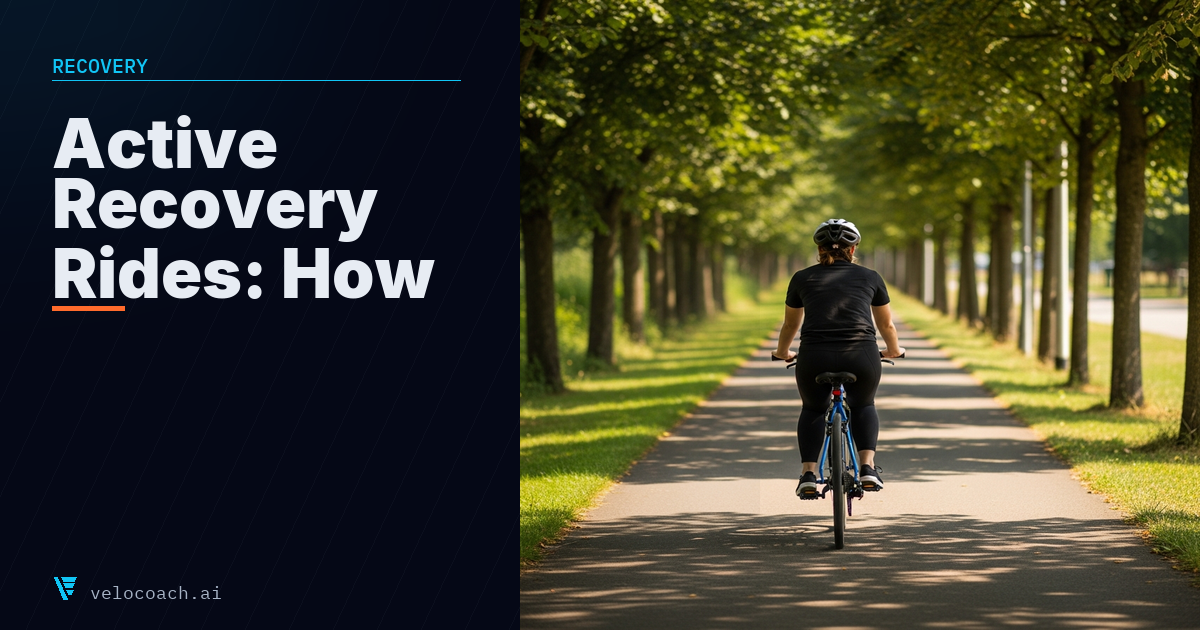
Active Recovery Rides: How to Do Them Correctly (And Why Most Cyclists Get This Wrong)
Active recovery rides are one of the most misunderstood training tools in cycling. They look easy on paper (just ride slowly) but are frequently executed in ways that undermine their purpose. Understanding what they are actually supposed to achieve, and why the details of execution matter, changes how you approach your easy days.
What Active Recovery Is For
An active recovery ride is not a training session. It is a recovery intervention that uses gentle movement to support the physiological processes of returning to readiness after hard training.
The mechanisms through which it works:
Increased blood flow without additional stress. Gentle movement significantly increases blood flow through working muscles without creating meaningful metabolic stress. This enhanced circulation helps clear metabolic by-products (hydrogen ions, lactate, waste products) from the previous session's efforts and delivers oxygen and nutrients to recovering tissue.
Maintenance of movement quality. Days of complete sedentary rest can create a stiffness and heavy-legged feeling in trained cyclists, partly from reduced blood flow and partly from reduced neural activity in the muscles. A short, gentle ride maintains movement patterns and proprioception without adding training load.
Psychological continuity. For consistent cyclists, a complete day off can feel unproductive and disruptive. A short easy ride satisfies the need to do something while contributing to recovery rather than impeding it.
Parasympathetic stimulation. Easy aerobic exercise at very low intensities is associated with parasympathetic nervous system activation (the "rest and digest" state that underpins recovery). This is distinct from the sympathetic activation of hard training.
The Intensity Question: Why Most Active Recovery Rides Are Too Hard
The most common failure mode of active recovery rides is that they are performed too hard. A cyclist who is capable of training at 280W FTP goes out for an "easy" ride, feels fresh and good, and rides at 200W for an hour. This is not active recovery. This is Zone 2 training, which is a legitimate training stimulus but a poor recovery intervention.
True active recovery should be at Zone 1 intensity: very easy aerobic exercise, typically defined as below 55% of FTP or below 65% of maximum heart rate. The effort should feel almost embarrassingly easy. Perceived exertion should be 2 to 3 out of 10.
At this intensity, blood flow is meaningfully elevated above resting without placing significant metabolic demand on the muscles. The cardiovascular system is not stressed. The neuromuscular system is barely engaged. This is exactly the profile needed for a recovery ride to contribute positively rather than add to the accumulated stress.
The test: if you are breathing hard, if your legs feel any burn, or if you would describe the effort as "moderate," you are not in active recovery territory.
Duration: Shorter Than You Think
Active recovery rides should be short. 30 to 60 minutes is the appropriate range for most cyclists. The goal is to use gentle movement to support recovery, not to add training volume.
Riders who extend active recovery rides to 90 minutes or 2 hours because "it was so easy" are missing the point. Even at low intensity, 2 hours of cycling adds meaningful Load (typically 40 to 70, depending on power), increases Fatigue, and occupies time that could be spent sleeping or eating, both of which are more valuable recovery interventions.
A 45-minute Zone 1 spin at 40 to 50% FTP achieves the physiological goal of active recovery without meaningfully adding to training stress.
When to Use Active Recovery vs Complete Rest
Not every recovery day needs to be an active recovery ride. For athletes in heavy training blocks, complete rest days (no deliberate exercise) are often more appropriate than active recovery, because:
- Cumulative fatigue is higher
- The marginal recovery benefit of gentle cycling is outweighed by total rest
- Sleep is often more valuable than a 30-minute spin
Active recovery is most appropriate when: - Acute muscle soreness or stiffness is the dominant issue (blood flow helps more than total rest) - You are in a moderate training phase where fatigue is present but not severe - You have two hard days in sequence and want to maintain movement quality between them - You are tapering for an event and want to keep the legs moving without adding stress
Complete rest is more appropriate when: - You are genuinely exhausted (more than just sore and tired) - You have been in a hard block for several weeks - Your HRV is significantly depressed - You are fighting off illness
Execution Tips
Leave the power meter at home (or ignore it). Or set it to average power display only. Active recovery rides are better guided by feel and heart rate than by power. The goal is simply "feels easy and heart rate stays low."
Avoid hills. Inclines force power up involuntarily, pulling you out of Zone 1. Flat routes or a turbo trainer at very low resistance are better environments for controlled active recovery.
Avoid groups. Group rides inevitably drift upward in pace as riders try to stay together. Solo rides are far easier to execute at genuine recovery intensity.
Stay off the phone (but consider music or podcasts). Easy solo rides at low intensity are more mentally sustainable with entertainment. This is also a good opportunity for a completely mentally disengaged ride, which can be its own form of recovery.
Time it relative to your next session. If your next hard session is in the evening, a morning active recovery ride is fine. If your next hard session is the next morning, ride in the afternoon or evening of the recovery day and allow full overnight recovery before the quality session.
The Load Accounting Reality
For structured cyclists tracking Load: an active recovery ride of 45 minutes at 45% FTP will generate a Load of approximately 10 to 15. This is intentionally very low. In the context of a training week where each hard session carries a Load of 100 to 150, a recovery ride of 10 to 15 does not meaningfully add to Fatigue and supports Fitness maintenance without impeding Form recovery.
---
Train with a coach that reads your data
VeloCoach AI connects to Garmin, Wahoo, Intervals.icu and Apple Health, and tells you exactly what to do next.
Download on the App Store