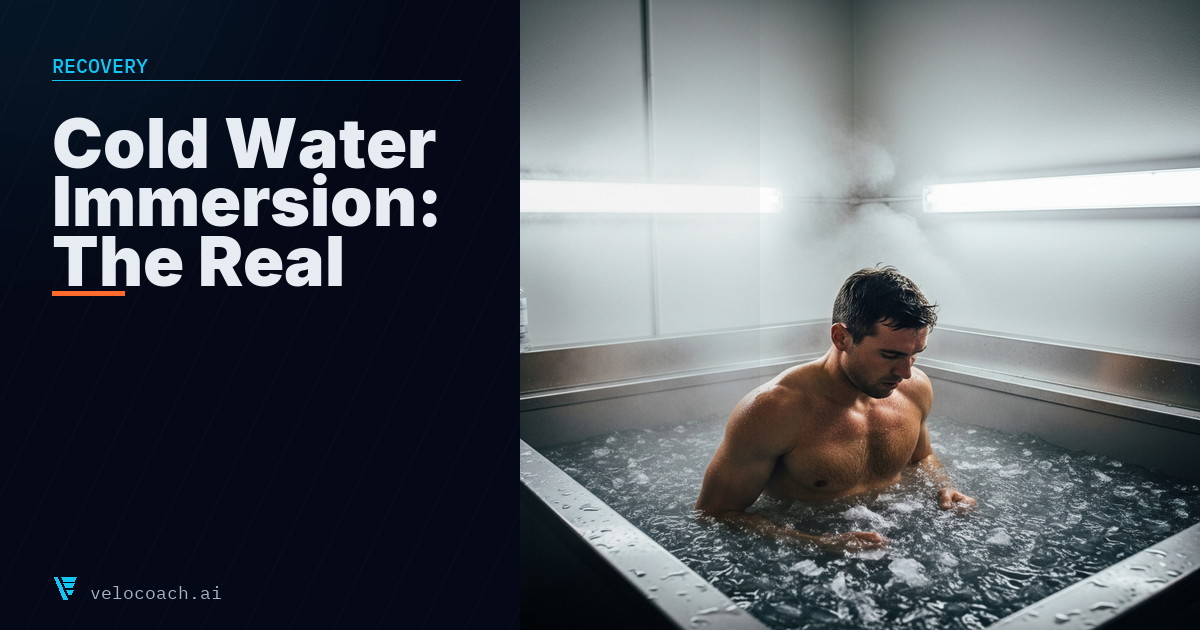
Cold Water Immersion: The Real Story Behind the Ice Bath
Ice baths have been a staple of professional sports recovery for decades. Social media has amplified the narrative significantly, with coaches and athletes across cycling and triathlon photographing post-race ice baths as a signal of serious training. More recently, the science has complicated this picture considerably, and the current evidence supports a more nuanced approach than "always use ice baths, they work."
Why Cold Water Immersion Became Popular
The original rationale for cold water immersion (CWI) was straightforward: reducing tissue temperature decreases inflammation and swelling, reduces nerve conduction velocity (blunting pain), and constricts blood vessels (reducing muscle damage markers in circulation). Athletes reported feeling better after cold immersion, and some performance markers (perceived muscle soreness, blood markers of inflammation) improved.
This was enough to embed CWI in professional sports recovery culture, and the practice spread well beyond the evidence base.
What Cold Water Immersion Actually Does
The acute effects of CWI are real:
Reduced muscle soreness. A 2024 Cochrane review of 28 randomised controlled trials found that CWI significantly reduced delayed onset muscle soreness (DOMS) compared to passive rest. The effect was consistent and moderate in magnitude. This is the most robust finding in the CWI literature.
Reduced perception of fatigue. Athletes consistently report feeling fresher in the hours after CWI. This is partly real (reduced soreness makes movement feel easier) and partly psychological, though the psychological effect is still performance-relevant.
Reduced markers of muscle damage. Blood markers of muscle damage (creatine kinase, myoglobin) are reduced after CWI. These markers do not perfectly correspond to actual functional recovery, but their reduction suggests reduced acute tissue disruption.
Potential for faster functional recovery between bouts. In competition contexts where athletes need to perform again within 24 to 48 hours, CWI may help maintain performance in subsequent efforts. A 2023 study of track cyclists found that athletes who used CWI between two maximal sprint sessions maintained 98% of initial sprint power in the second session, versus 91% in the non-CWI group.
The Adaptation Blunting Problem
This is where the picture becomes more complex. The same inflammatory and anabolic processes that CWI suppresses in the short term are also signals for long-term training adaptation.
When you train hard, the acute inflammatory response is not just damage, it is part of the molecular signalling cascade that drives adaptation. Cytokines and other inflammatory mediators trigger satellite cell activation, protein synthesis, and mitochondrial biogenesis. The soreness and inflammation are, to an extent, the cost of adaptation.
A landmark 2015 study by Roberts and colleagues, published in the Journal of Physiology, randomised strength and endurance athletes to either CWI or active recovery after resistance training. At 12 weeks, the CWI group showed significantly lower gains in muscle mass, strength, and Type II fibre hypertrophy despite performing the same training programme. The inflammation-blunting effect of repeated CWI had impaired the adaptation that would have occurred from the training stimulus.
More recent work has extended this finding to endurance contexts. A 2023 study in trained cyclists found that 4 weeks of post-training CWI (compared to thermoneutral water) produced smaller improvements in aerobic enzyme activity and mitochondrial markers, suggesting blunted aerobic adaptation from repeated CWI use during training.
How to Use CWI Intelligently
The current evidence supports a conditional rather than blanket approach to CWI:
Use CWI in competition contexts. When you are racing multiple days (a stage race, a multi-day event), the priority is performance recovery, not training adaptation. Using CWI between race days is appropriate and supported. The adaptation cost does not matter when you are not trying to generate new adaptations.
Use CWI when rapid recovery between sessions is genuinely necessary. Double training days or back-to-back hard sessions within a block can benefit from CWI if full recovery is critical for session quality. Again, the adaptation cost is an acceptable trade-off.
Avoid routine CWI after quality training sessions. After a threshold, VO2 max, or strength session where adaptation is the goal, using CWI regularly over weeks or months will blunt the adaptation you are trying to build. It is counterproductive.
Use CWI selectively, not habitually. The pattern of using CWI after every hard session, as a reflexive recovery ritual, is the practice the evidence most clearly argues against.
Practical Protocol
When using CWI is appropriate, the optimally studied protocol is:
- Water temperature: 11 to 15°C (40 to 50% effectiveness falls off at warmer temperatures, and temperatures below 10°C add risk without additional benefit in most studies)
- Duration: 10 to 15 minutes
- Immersion depth: at least to the waist; full immersion if possible
- Timing: within 30 to 60 minutes of exercise cessation
Cold showers have some similar effects but at reduced magnitude. They are a reasonable middle ground when ice bath access is not available.
Contrast Therapy
Alternating hot and cold water immersion (contrast therapy) is popular in sports recovery settings. The evidence for contrast therapy producing superior outcomes to CWI alone is limited. Some studies show improved perceptual recovery; functional recovery benefits are less clear. If your training facility or race venue has contrast facilities, using them is not harmful and may help with perception of recovery.
The Practical Decision Framework
Post-training session in a base or build phase, trying to maximise adaptation: skip CWI. Use a cool-down ride, adequate fuelling, and sleep instead.
Competition day or day before a key race: CWI is appropriate if you respond well to it and have access.
The afternoon before back-to-back morning training sessions: borderline. Mild CWI (15°C, 10 minutes) probably does not blunt adaptation significantly and may improve next-day readiness.
---
Train with a coach that reads your data
VeloCoach AI connects to Garmin, Wahoo, Intervals.icu and Apple Health, and tells you exactly what to do next.
Download on the App Store