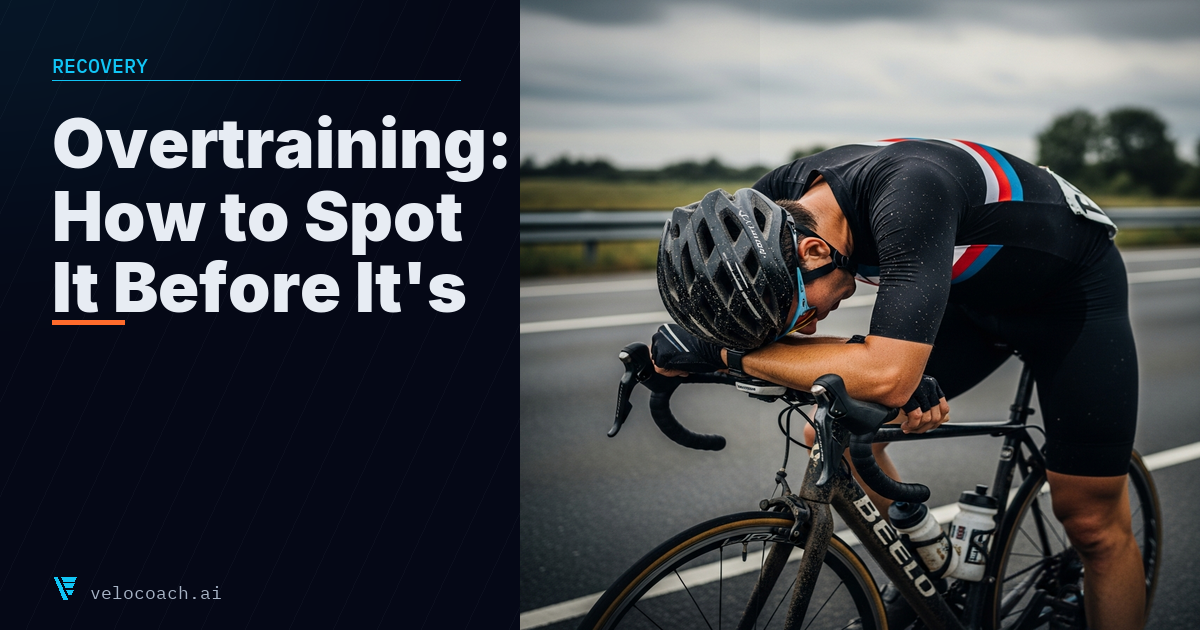
How to Know If You're Overtraining Before It's Too Late
Overtraining syndrome does not arrive suddenly. It builds gradually, across weeks or months, through a series of signals that are easy to dismiss, rationalise, or miss entirely if you are not looking for them.
By the time most athletes get a diagnosis, they are already in non-functional overreaching at minimum, and some are deep into true overtraining syndrome, a condition that can take six to twelve months to fully recover from. With no shortcuts.
Understanding the progression, the warning signals in your data and your body, and how to respond before the condition worsens is one of the highest-value things a cyclist can know.
The Three Stages
It helps to think of overtraining as a spectrum with three stages of increasing severity.
Stage 1: Functional Overreaching
This is normal and expected in structured training. A hard training block deliberately pushes your training load above sustainable levels for a short period. Acute fatigue accumulates. Performance temporarily decreases. With 7 to 14 days of reduced load or full recovery, you rebound to a new performance high. This is supercompensation, the fundamental mechanism of training-induced adaptation.
The critical word is "temporary." Functional overreaching is planned and brief. Recovery follows deliberately. Most athletes experience this during and after hard training blocks and race-prep periods.
Stage 2: Non-Functional Overreaching
Here, the athlete has pushed beyond what their recovery can accommodate, and the fatigue has moved from acute to chronic. Performance stays depressed. Recovery takes two to six weeks even with appropriate rest. No fitness gain is realised from the preceding training block. The load was simply too much.
Non-functional overreaching often develops when: - A cyclist ramps training load too quickly without adequate easy days - Rest weeks are consistently skipped or cut short because the athlete "feels fine" - Life stress (work, sleep disruption, illness) adds to training stress without a corresponding reduction in training load - Multiple hard weeks stack without a genuine recovery week between them
The athlete in this stage typically feels chronically fatigued, notices their power outputs stalling or declining, and may dismiss it as temporary. This is where early intervention matters most.
Stage 3: Overtraining Syndrome
The pathological extreme. True overtraining syndrome (OTS) is associated with hormonal dysregulation, immune suppression, central nervous system disturbance, and psychological effects including depression and loss of motivation. Recovery takes a minimum of three months and often six to twelve months or longer. An estimated 60% of elite athletes experience OTS at some point in their career.
No cyclist reaches OTS in a single training week. It is the consequence of sustained non-functional overreaching without adequate intervention.
The Early Warning Signs in Your Data
This is where your training metrics earn their value. The signals typically appear in your data before they are obvious in your body.
Form trends deeply negative and stays there. Your Form (Fitness minus Fatigue) represents the relationship between your accumulated fitness and your acute fatigue. A normal hard training block might push Form to -20 to -30 temporarily. Sustained Form at -35 or below, for multiple consecutive weeks without recovery, is a warning flag. The body is accruing more stress than it is resolving.
HRV sustained below baseline. Acute fatigue will suppress HRV for a day or two after a hard session. Non-functional overreaching shows up as persistent HRV suppression across four or more consecutive days, even on rest days when HRV would normally recover. This reflects autonomic nervous system fatigue that is not clearing with normal rest.
Resting heart rate elevated above baseline. A resting HR sitting five or more beats above your established baseline for multiple days consecutively signals that sympathetic nervous system activation is elevated at rest. Under normal training, resting HR should return to baseline within a day of hard training.
Power flat or declining at the same RPE. You produce the same power as four weeks ago despite consistent training. Or your power is actually lower at a given effort level than it was previously. When this pattern holds for two or more weeks despite adequate rest days, it is not a plateau you can train through. It is a signal to investigate.
Fitness stalling despite continued training. Fitness should be building gradually through a training block. If your Fitness has flatlined or declined while you are training, you are not absorbing the training stress. The recovery side of the equation is failing.
The Early Warning Signs in Your Body
Alongside the data signals, subjective experience provides important information:
Motivation loss. A previously motivated cyclist who starts finding excuses to miss sessions or feels genuine dread before training is experiencing something different from normal fatigue. Motivation is neurologically regulated and is one of the first things to suffer in overreaching.
Sleep quality deteriorating. Paradoxically, overreached athletes often struggle to sleep despite being exhausted. High cortisol levels and sympathetic nervous system activation interfere with sleep quality. Poor sleep further impairs recovery, compounding the problem.
Persistent muscle soreness. DOMS that lasts more than 72 hours after a moderate session suggests that repair processes are not keeping pace with training damage. This is a soft tissue warning as much as a systemic one.
Mood changes. Irritability, flat affect, difficulty concentrating, and mild depression are documented features of non-functional overreaching and OTS. These are physiological in origin, not psychological weakness. The neuroendocrine system is dysregulated.
Frequent illness. Three or more upper respiratory tract infections in a training season, particularly if they correspond to your hardest training periods, suggests that immune function is compromised by training load.
What to Do
At the first sign of non-functional overreaching: Reduce training load immediately. This means genuine reduction, not a slightly easier version of your current schedule. Cut volume by 30-50% and intensity dramatically for at least one week. If symptoms improve, extend the reduced load for a second week before gradually re-introducing intensity.
If multiple signals are present simultaneously: Take a full recovery week with only Zone 1 activity or complete rest. After seven days, reassess all metrics and subjective wellbeing. Do not rush back to hard training.
If symptoms persist after two weeks of reduced load: Consider a full 4-6 week recovery block with a gradual return to structured training. Seek support from a sports medicine practitioner if mood disturbance or significant illness accompanies the training suppression.
To prevent it from happening again: Protect your rest weeks as fiercely as you protect your quality sessions. Skipping a rest week because you feel good is one of the most common errors in self-coached training. Form rising and HRV recovering is what a successful rest week looks like from the data side. Trust the data over how you feel.
Related Reading
- Training With Your Cycle: What the Research Actually Says: REDs and chronic low energy availability are over-represented in female endurance athletes. If overtraining symptoms persist, energy availability is the first thing to rule out.
Train with a coach that reads your data
VeloCoach AI connects to Garmin, Wahoo, Intervals.icu and Apple Health, and tells you exactly what to do next.
Download on the App Store