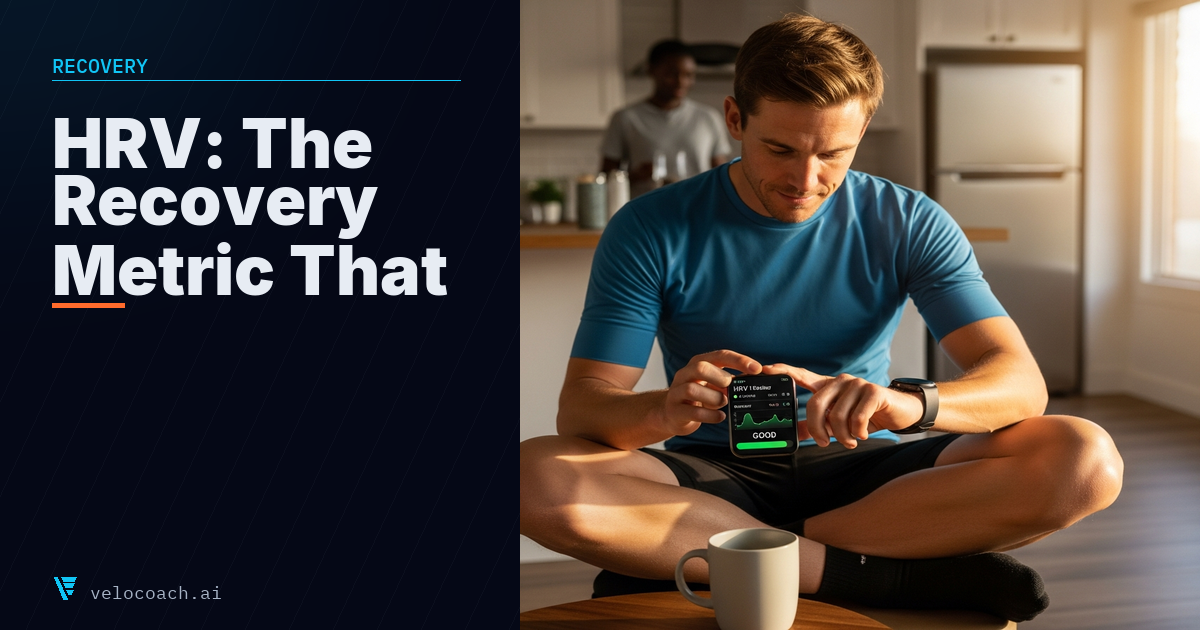
HRV for Cyclists: How to Stop Guessing and Start Training by Data
Every morning, before your first coffee, your body already knows whether today should be a hard training day or an easy one. The problem is, most cyclists have no way to hear what it's saying.
Heart rate variability gives you that signal. It is one of the most practical tools available for making daily training decisions based on your actual physiological state, rather than what the programme says you should be doing. Used correctly, it tells you when to push and when to back off before your performance forces the decision for you.
Here is how it works, what the current research shows, and how to use it practically.
What HRV Actually Is
Your heart does not beat like a metronome. The interval between beats varies slightly with each cycle, speeding up slightly on the inhale and slowing slightly on the exhale. This variation is controlled by your autonomic nervous system, specifically the balance between the sympathetic ("fight or flight") and parasympathetic ("rest and digest") branches.
When you are well recovered, parasympathetic activity is high, and the variation between heartbeats is larger. When you are fatigued, stressed, or fighting off illness, sympathetic activity dominates, the heart becomes more metronomic, and HRV drops.
The most widely used HRV metric is RMSSD: the root mean square of successive differences between R-R intervals. You do not need to understand the maths. You need to understand that RMSSD rises when you are recovered and drops when you are not.
HRV can be measured with a chest strap or compatible wristband HR monitor, or with some smartwatches. Apps like HRV4Training and Elite HRV guide the measurement and track trends over time.
What the Research Shows
A study published in Scientific Reports in 2025 evaluated 28 experienced male cyclists training across a 40-day period. Three groups were compared: one using only HRV (vmHRV) to guide training intensity decisions; one using HRV plus subjective wellbeing scores; and one using HRV, wellbeing scores, and resting heart rate together.
The finding was clear: combining HRV with resting heart rate and subjective wellbeing outperformed using HRV alone. Athletes in the combined group made better training decisions, accumulated training load more appropriately, and showed greater performance gains over the study period.
This matters because it shows two things. First, HRV guidance works. Athletes who adjusted training based on their HRV data outperformed those following a fixed programme. Second, HRV is most powerful as part of a picture rather than in isolation. A low HRV score on a day when you feel excellent and your resting heart rate is normal might be noise. When all three signals align, you have a stronger signal.
A broader systematic review found that HRV-guided training significantly improved aerobic fitness and endurance performance compared to traditional fixed-load training approaches, particularly over intervention periods of eight weeks or longer.
Why HRV Is Especially Useful for Cyclists
Cycling training creates significant and variable physiological stress. A three-hour endurance ride, a hard threshold session, and a two-day stage race are all different in character. Layering life stress on top of training stress (poor sleep, work pressure, illness) compounds the recovery demand in ways that are invisible to a fixed weekly training plan.
HRV captures this. It is sensitive to all sources of autonomic stress, not just training load. A night of poor sleep depresses HRV in ways that mirror additional training stress. A high-stress week at work often shows up in HRV before it shows up in your power data.
This makes HRV particularly valuable for identifying overreaching early. Sustained HRV suppression over several days, particularly when combined with flat power outputs and mood changes, is one of the earliest objective signals that you are accumulating more training debt than you are recovering from.
How to Use HRV Practically
Measure first thing. Take your HRV reading before you get out of bed, before caffeine, before you check your phone. Consistency of measurement timing is more important than the absolute numbers. Ideally measure every morning, even on rest days.
Track your baseline. HRV is highly individual. A "good" HRV score for one cyclist might be low for another. What matters is your personal trend. Most apps establish a baseline over two to four weeks of consistent measurement, then flag meaningful deviations from that baseline.
Use a decision framework, not a hard rule. A single low HRV reading does not mean cancel the session. It means pay attention. If your HRV is down and you feel flat and your resting heart rate is elevated, that is three signals pointing the same direction. Swap your threshold session for a Zone 2 ride and reassess tomorrow.
If your HRV is down but you slept well, feel good, and your resting HR is normal, the reading might be noise. Proceed with the session but monitor how it feels from the first interval.
Use green and amber days. Many practitioners use a simple three-colour system. Green: HRV at or above baseline, proceed as planned. Amber: HRV slightly below baseline, reduce session intensity or volume by 10-20%. Red: HRV significantly suppressed, or suppressed for multiple consecutive days, reduce to easy riding or full rest.
Look for suppression trends, not daily fluctuations. Day-to-day HRV fluctuates for many minor reasons. What matters is when your HRV is consistently below baseline for four or more consecutive days. That sustained suppression is a reliable indicator of accumulated stress.
What HRV Cannot Tell You
HRV is not a substitute for all other training data. It does not tell you your fitness is improving. It does not replace Fitness, Fatigue and Form as a way of tracking your training load trajectory. It does not tell you what caused the suppression.
Think of HRV as one layer in a system. Your Fitness tells you about your long-term trajectory. Your Form tells you whether you are rested or fatigued relative to your baseline. Your HRV tells you what your nervous system thinks of this morning, right now. All three together give you a richer picture than any single metric alone.
Related Reading
- Training With Your Cycle: What the Research Actually Says: HRV and resting heart rate vary across the menstrual cycle. If you track HRV and have a cycle, this article matters.
Train with a coach that reads your data
VeloCoach AI connects to Garmin, Wahoo, Intervals.icu and Apple Health, and tells you exactly what to do next.
Download on the App Store