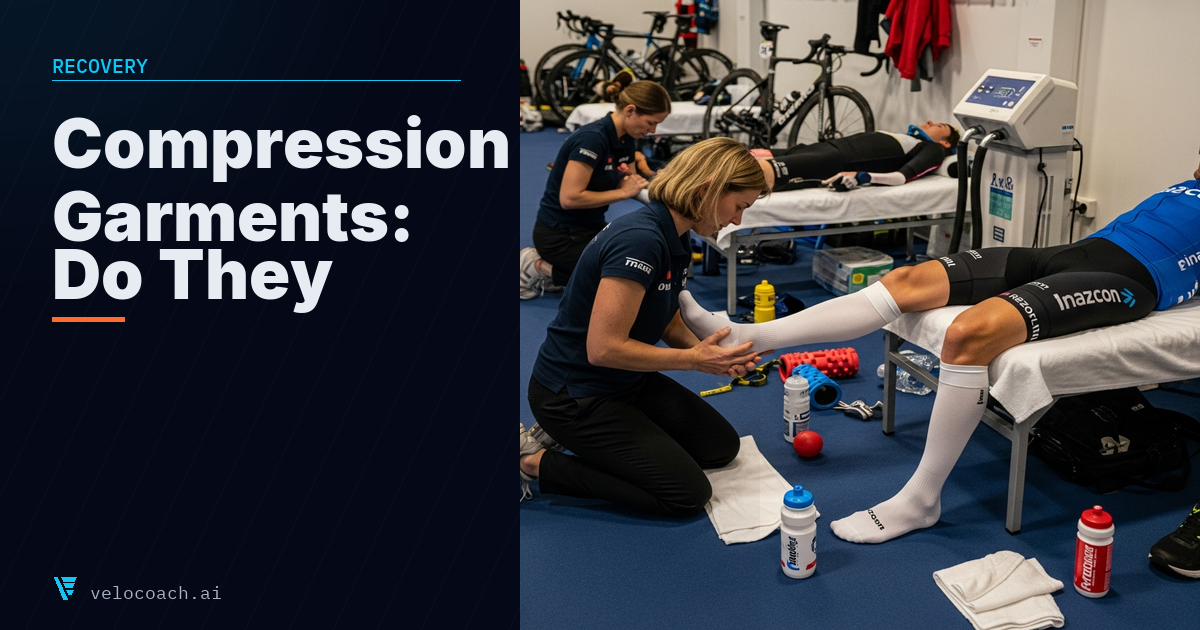
Compression Garments for Cyclists: Do They Actually Work?
Compression socks and tights are ubiquitous in endurance sports. Professional cyclists wear them on the bike, in the team bus, and at the hotel after stages. Amateur cyclists pull on compression socks for post-ride recovery and long travel days. The question worth asking honestly is whether the evidence justifies this investment or whether compression garments have succeeded on the strength of professional visibility and sophisticated marketing.
The answer, as with many recovery tools, is "it depends on what you expect them to do."
What Compression Garments Are Designed to Do
Graduated compression garments apply higher pressure at the periphery (the ankle for compression socks, the lower leg for calf sleeves) and progressively less pressure moving proximally. The original clinical application was medical: graduated compression stockings reduce venous blood pooling in the legs of patients with circulatory disorders, reduce oedema, and lower deep vein thrombosis risk.
The sports application borrowed from this logic: reduce venous blood pooling in fatigued muscles after exercise, improve blood and lymphatic return, reduce muscle oscillation during exercise, and lower the metabolic cost of running or cycling.
The Evidence: What Works
Venous blood return and oedema reduction. This is the best-supported benefit. Graduated compression socks consistently reduce lower limb swelling and venous blood pooling during and after prolonged exercise. This effect is most pronounced in prolonged, low-intensity activity (long travel, standing recovery), and the magnitude corresponds to the compression grade: Class 2 medical compression (23 to 32 mmHg) produces larger effects than most sports compression garments (typically 15 to 25 mmHg).
Reduced DOMS after exercise. A 2023 systematic review found that wearing compression garments in the 24 to 48 hours following intense exercise significantly reduced perceived muscle soreness compared to control conditions. Effect sizes were moderate. The mechanism is likely the reduction in oedema and improved waste product clearance enabled by improved venous return.
Improved recovery between exercise bouts. Several studies of compression worn between two exercise sessions (in a competition or multi-day event context) showed improved performance maintenance in the second bout. A 2024 study of cycling time trialists found that wearing lower-leg compression between two time trials performed 6 hours apart improved second-bout power by approximately 2% compared to no compression.
Long-haul travel recovery. The clinical DVT-prevention application translates directly to long-haul flights and road travel to events. For cyclists flying to a race or spending 4 to 8 hours in a car or plane, compression socks reduce venous pooling and swelling that would otherwise impair the subsequent few days' performance. This is probably the most clearly justified application.
The Evidence: What Probably Does Not Work
Performance enhancement during cycling. Despite the professional visibility of compression worn on the bike, the evidence for compression improving cycling performance during exercise is weak. A 2023 meta-analysis found no significant improvement in VO2 max, lactate threshold, or time trial performance from wearing compression during cycling. The haemodynamic benefit (improved venous return) does not translate to increased exercise capacity in well-conditioned cyclists who are already managing venous return adequately through muscular contraction.
Muscle damage prevention. Compression garments do not meaningfully prevent exercise-induced muscle damage. They reduce the downstream symptoms (soreness) but do not reduce the actual degree of muscle microtrauma from training.
Improved aerobic metrics from post-exercise compression. Claims that compression accelerates restoration of VO2 max or FTP after exercise are not supported by high-quality evidence. Perceived recovery improves; measured metabolic recovery is less clearly accelerated.
Compression Level and Fit Matter
Not all compression garments are equal. The majority of sports compression socks available in cycling retailers provide 15 to 20 mmHg of compression, the lower end of therapeutic range. For general post-exercise wear, this is adequate for the oedema and venous pooling benefits.
For travel or more pronounced recovery applications, Class 1 (18 to 21 mmHg) or Class 2 (23 to 32 mmHg) medical grade compression provides stronger haemodynamic effects. These are available from medical suppliers and pharmacies for modest cost.
Fit is also critical. A poorly fitting compression garment that is too loose provides no meaningful pressure gradient. Garments should feel snug (not painful or restrictive) throughout their length, with the highest pressure at the ankle.
Practical Recommendations
Post-hard session or race: Wearing compression socks or tights for 2 to 6 hours post-exercise is the best-evidenced recovery application. Particularly useful after long or intense rides, in the hours before a subsequent training day.
Long-haul travel to events: Wear compression socks for any flight or journey over 3 hours. The DVT prevention and swelling reduction are well-evidenced and practically significant.
Multi-day racing or stage events: Wearing compression between stages (on the bus, in the hotel) has more evidence than wearing it during racing itself. Worth using consistently between stages.
Overnight compression: Some athletes wear compression socks overnight after hard efforts. The evidence for specific overnight benefit is limited; if it is comfortable, no harm is done, but it is not clearly superior to simply elevating the legs.
Not recommended: Expensive compression garments with complex graduated architectures or proprietary materials that cost significantly more than standard graduated compression socks. The basic mechanism is pressure gradient, and this is provided adequately by standard medical-grade compression at a fraction of the price of premium sports-marketing versions.
The evidence ultimately supports compression socks as a useful, low-risk recovery tool with real but modest benefits for post-exercise soreness and venous return. They are not a performance-enhancing device, and the professional visibility on bikes during racing says more about branding relationships than science.
---
Train with a coach that reads your data
VeloCoach AI connects to Garmin, Wahoo, Intervals.icu and Apple Health, and tells you exactly what to do next.
Download on the App Store