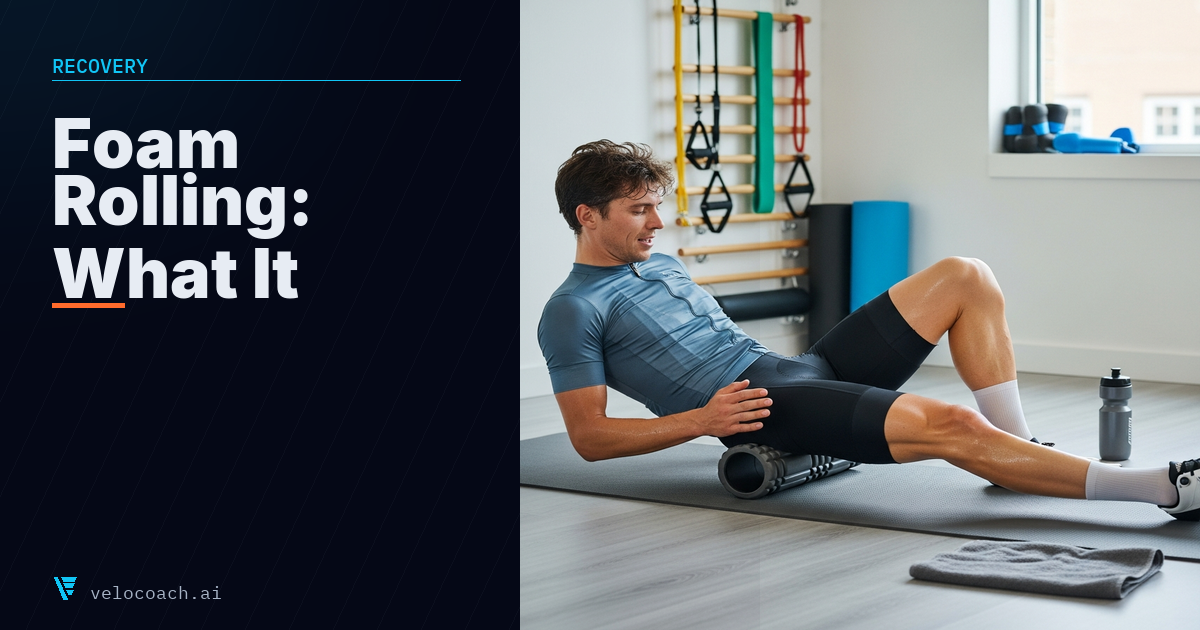
Foam Rolling and Massage: What the Evidence Actually Shows
Foam rollers are one of the most purchased pieces of fitness equipment. They live in training rooms, under desks, and in the corner of every cycling-adjacent gym. Whether most cyclists are using them in a way that achieves anything meaningful is a different question.
The evidence on self-myofascial release (SMR) and massage for cyclists is more nuanced than both the enthusiastic marketing and the dismissive backlash suggest.
What Foam Rolling Is Trying to Do
The original theoretical basis for foam rolling involved "myofascial release": mechanical pressure on muscle and connective tissue releasing adhesions between fascia and muscle, improving tissue sliding, and reducing restrictions in movement. This mechanism has been questioned by more recent research; the pressures achievable with a foam roller are probably insufficient to mechanically alter fascial structure.
More likely mechanisms behind any foam rolling benefits:
Neurological modulation. Sustained pressure on muscle tissue stimulates mechanoreceptors and alters the nervous system's perception of that tissue. Pain thresholds increase (the area hurts less), muscle tone reduces slightly, and the perceived range of motion improves. These are neural rather than structural changes.
Blood flow and metabolite clearance. Compression and release of muscle tissue promotes local blood flow in the period following rolling. This may help clear metabolic by-products from the preceding exercise session.
Psychological readiness. Feeling less tight and sore before training, regardless of the mechanism, has real effects on subsequent performance. Psychological readiness to train hard is a genuine performance variable.
What the Research Shows
On muscle soreness (DOMS): This is the strongest evidence base for foam rolling. A 2020 systematic review in Sports Medicine found that foam rolling reduced delayed onset muscle soreness compared to passive rest across multiple studies. Effect sizes were moderate. The effect is real, though smaller than often claimed.
On flexibility and range of motion: Immediate improvements in flexibility are consistently found after foam rolling, lasting 10 to 30 minutes. These are almost certainly neurological rather than structural. For a warm-up context (improving movement quality before training), this is a useful practical effect. For permanent flexibility improvements, foam rolling has limited evidence.
On performance: Post-exercise foam rolling does not meaningfully improve subsequent performance in most studies. The soreness reduction is genuine, but translating to power output, VO2 max, or race performance is not well-evidenced. Foam rolling is a recovery modality, not a performance-enhancement tool.
On actual tissue structure: Despite the marketing, there is no robust evidence that foam rolling alters fascial adhesions, changes muscle fibre arrangement, or produces structural tissue changes. The benefits are functional, not structural.
Professional Massage
Sports massage by a qualified therapist is a different proposition from foam rolling. A therapist can apply higher and more varied pressures, identify specific tissue restrictions, and use techniques beyond what self-massage can achieve.
The evidence for professional massage in cyclists includes:
Improved perceived recovery. Consistently reported, across studies and in professional teams' experience. Cyclists feel better and are more willing to train after massage.
Reduced DOMS. A 2024 systematic review found that massage performed within 72 hours of intense exercise reduced DOMS significantly compared to passive recovery, with effects comparable to or slightly exceeding CWI.
Possible injury prevention. Several professional teams report reduced soft tissue injury rates in cyclists who receive regular massage, though controlled evidence here is limited. The regular hands-on assessment of a therapist may be as valuable as the massage itself for identifying developing problems before they become injuries.
What massage does not clearly do: improve aerobic performance metrics, accelerate muscle protein synthesis, or produce structural tissue changes comparable to physical therapy or specific rehabilitation interventions.
How to Use Foam Rolling Effectively
The practical use cases where foam rolling is worth the time:
Pre-training warm-up: 5 to 10 minutes of rolling major muscle groups (quads, hamstrings, glutes, calves, thoracic spine) before training increases acute range of motion and perceived readiness. This is a legitimate use, particularly before sessions where movement quality matters (strength sessions, hard interval sessions, races).
Post-training cooldown: Rolling after a session, particularly after efforts that produce significant muscle soreness, may reduce next-day DOMS. 10 to 15 minutes focusing on the most fatigued areas.
Regular maintenance: Some cyclists find 10 to 15 minutes of daily rolling, not tied to specific sessions, helpful for general tissue quality and chronic soreness management. The evidence for specific benefit is weaker here, but the practice is low-risk and if it supports consistency, it has value.
What rolling does not replace: Adequate warm-up, progressive training load management, adequate sleep and nutrition, and genuine recovery. Foam rolling is an adjunct to these, not a substitute.
Technique Matters
Rolling too quickly (a common error) reduces effectiveness. Slow, controlled passes with 2 to 3 second pauses on tender areas are more effective than rapid back-and-forth movement. Holding pressure on a tender spot for 20 to 30 seconds (a technique called pin and hold) may improve neurological response.
Avoid rolling directly on joints, bony prominences, or areas of acute injury. The IT band is a commonly rolled area where the evidence for benefit is specifically weak: the IT band itself is a dense, relatively non-compressible structure. Rolling the lateral quad and the proximal and distal portions of the IT band is more productive than rolling the band directly.
Building a Practical Approach
For most road cyclists, a pragmatic approach:
- Pre-ride: 5 minutes on the areas that feel tight that day (typically quads, hamstrings, glutes, thoracic spine)
- Post-ride after hard sessions: 10 minutes on fatigued areas
- Monthly professional sports massage: for maintenance, injury monitoring, and the recovery benefits that exceed what self-massage can achieve
This approach is time-efficient, evidence-appropriate, and likely to support training consistency and wellbeing without over-investing in a modality whose benefits are real but modest.
---
Train with a coach that reads your data
VeloCoach AI connects to Garmin, Wahoo, Intervals.icu and Apple Health, and tells you exactly what to do next.
Download on the App Store