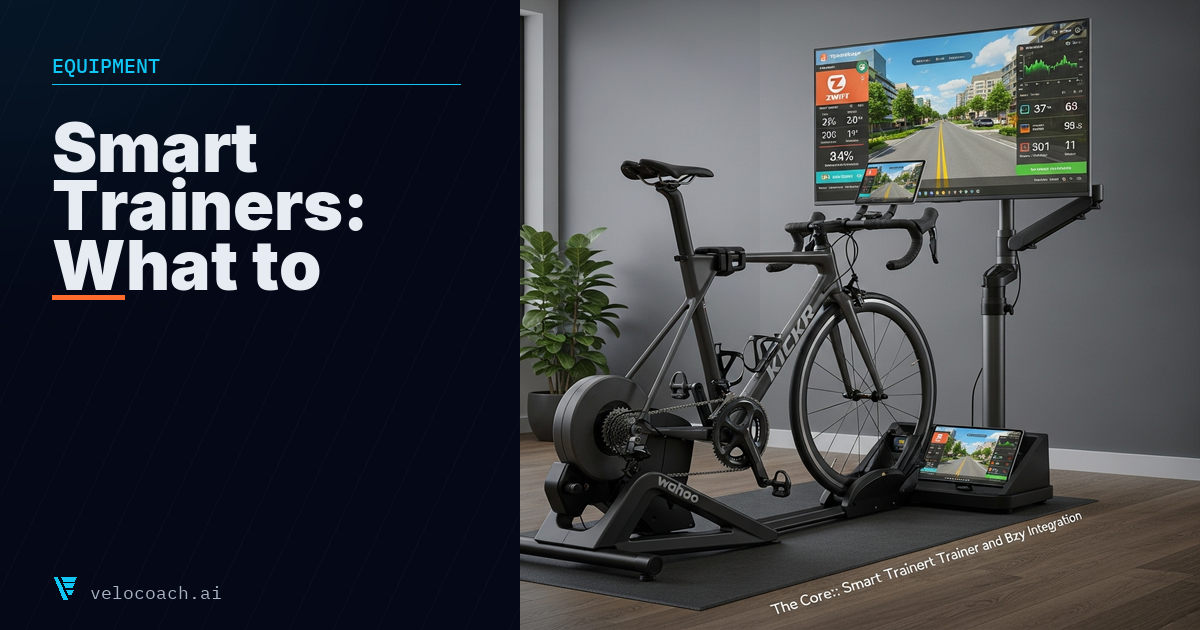
Smart Trainers: What to Look For and How to Get the Most From Indoor Training
Smart trainers have transformed indoor cycling from a tolerable necessity into a legitimate alternative to outdoor riding that many cyclists choose even when the weather is good. A quality smart trainer provides accurate power measurement, realistic feel, and complete integration with training platforms in a way that a basic wheel-on trainer simply cannot match.
If you are building a serious training setup, understanding what separates trainer quality levels and how to use indoor training effectively is worth the time.
Direct Drive vs Wheel-On Trainers
Wheel-on trainers clamp against the rear tyre, using the tyre's friction against a resistance roller to simulate effort. They are cheaper (£200 to £500 for quality smart units) and work with almost any bike. Their disadvantages: tyre wear, tyre slippage under high power, noise, and the accuracy limitation of measuring power through the resistance roller rather than directly.
Direct drive trainers require removing the rear wheel and mounting the bike directly onto the trainer's cassette and axle. The drivetrain contacts the trainer's resistance unit directly, with no tyre involved. Advantages: significantly quieter (the tyre-roller contact noise is eliminated), no tyre wear, more accurate and stable power measurement, and superior ERG mode performance under high torque loads.
Direct drive trainers cost £600 to £1,500 for quality units. For cyclists who train indoors regularly (more than 2 to 3 sessions per week), the direct drive experience and accuracy is worth the additional cost.
Key Specifications to Evaluate
Maximum power output and resistance gradient: High-quality trainers offer 2,000W maximum resistance or more, which allows simulating steep gradients without the resistance maxing out. The gradient simulation percentage (typically expressed as a maximum %, such as 20% for premium units) determines how accurately steep virtual climbs feel.
Flywheel weight: A heavier flywheel creates more road-feel inertia. When you accelerate, a heavier flywheel takes more effort to spin up but provides more realistic momentum. Most quality direct drive trainers have 4 to 6kg flywheels. Cheaper units may have 2 to 3kg, producing a less natural feel.
Power accuracy: Stated as ±%, similar to power meters. Top trainers (Wahoo Kickr, Tacx Neo, Saris H3) achieve ±1 to 2% accuracy out of the box. Lower-quality units may require more calibration and drift more with temperature.
Connectivity: Quality trainers support ANT+ FE-C and Bluetooth FTMS simultaneously, allowing connection to multiple devices (a head unit and a training platform simultaneously). Ensure your chosen trainer is compatible with the platforms you intend to use.
Noise: Critical for indoor training, particularly in flats, shared spaces, or during early mornings. Direct drive trainers are significantly quieter than wheel-on units. Trainers designed for low noise (Tacx Neo uses electromagnetic resistance rather than mechanical, producing extremely low noise) are worth the premium if neighbours or household members are a consideration.
Popular Options
Wahoo Kickr (Core/Kickr): The benchmark in the category. Excellent power accuracy, road-feel, ERG mode performance, and build quality. The Kickr Core (direct drive, lower spec flywheel) is the budget entry; the Kickr (full spec) is the performance choice.
Tacx Neo 2T: Magnetic resistance with no contact points produces near-silent operation. Excellent accuracy. Built-in road simulation through vibration. Good choice for noise-sensitive situations.
Elite Direto XR: Strong accuracy and ERG performance at a competitive price point. Good for cyclists who want direct drive quality without Wahoo or Tacx pricing.
Saris H3: Reliable, quiet, and accurate. Well-regarded for consistent power measurement.
ERG Mode: How to Use It Correctly
ERG mode automatically adjusts trainer resistance to maintain a target power regardless of cadence. If you slow your cadence, ERG increases resistance to maintain the same power. If you increase cadence, it decreases resistance.
This sounds ideal, and for most interval sessions it is. But ERG mode has failure modes that trip up many cyclists:
The ERG death spiral: If you let your cadence drop significantly below your target during a hard interval, ERG will increase resistance to compensate. Lower cadence + higher resistance makes it harder to maintain cadence, which causes cadence to drop further, which increases resistance further. The spiral ends in near-complete inability to pedal.
Prevention: never stop pedalling during an ERG-mode session and do not let your cadence drop below 80 rpm. If an interval is too hard, accept a power miss and keep cadence high until ERG can return to target. Stopping pedalling is the worst outcome.
ERG does not prepare you for the real world. In ERG mode, you never have to choose your own gear or manage your cadence against a variable gradient. For race preparation, resistance mode (where you control your own effort in a fixed resistance or simulated gradient environment) develops the self-regulation skills that actually transfer to outdoor racing.
Use ERG mode for structured intervals where hitting precise power targets is the goal. Use resistance or simulation mode for group rides, race simulations, or sessions where you want to practice real-world pacing.
Platforms: Getting the Most From Your Trainer
The trainer is hardware; the platform is the experience.
Zwift: The most popular platform. Virtual racing, group rides, structured workouts, and a persistent virtual world. Best for engagement and social interaction. Requires a subscription. Racing on Zwift is genuinely competitive and tactical.
TrainerRoad: Training-focused platform with structured plan and interval library. Excellent if your primary goal is structured training optimisation rather than entertainment or social riding. Adaptive training adjusts sessions based on your performance.
Rouvy: Video-based platform showing real roads synced to resistance changes. Good middle ground between simulation and outdoor feel.
Bkool: Similar to Rouvy with a different course library and community.
Native app with your trainer brand: Wahoo's native app, Tacx's app. Useful for basic calibration and simple sessions; generally not as feature-rich as dedicated platforms.
Setup and Environment
The physical training environment matters for consistency and quality.
Fan: Non-negotiable. Indoor cycling produces significantly more heat than outdoor cycling because there is no airflow. Without a dedicated fan (preferably a high-volume desk fan or a dedicated training fan like the Wahoo Headwind), core temperature rises, heart rate drifts, and perceived effort increases at any given power. A good fan reduces heat-related performance degradation and cardiac drift significantly.
Flooring: Trainer mat for sound dampening and sweat protection.
Screen and mounting: A tablet, monitor, or TV for the training platform at a comfortable viewing angle. Neck strain from a poorly positioned screen accumulates across training hours.
Ventilation: If possible, in a room with a window that can be opened. Carbon dioxide concentration in a sealed room increases during intense exercise and contributes to fatigue and headache.
---
Train with a coach that reads your data
VeloCoach AI connects to Garmin, Wahoo, Intervals.icu and Apple Health, and tells you exactly what to do next.
Download on the App Store