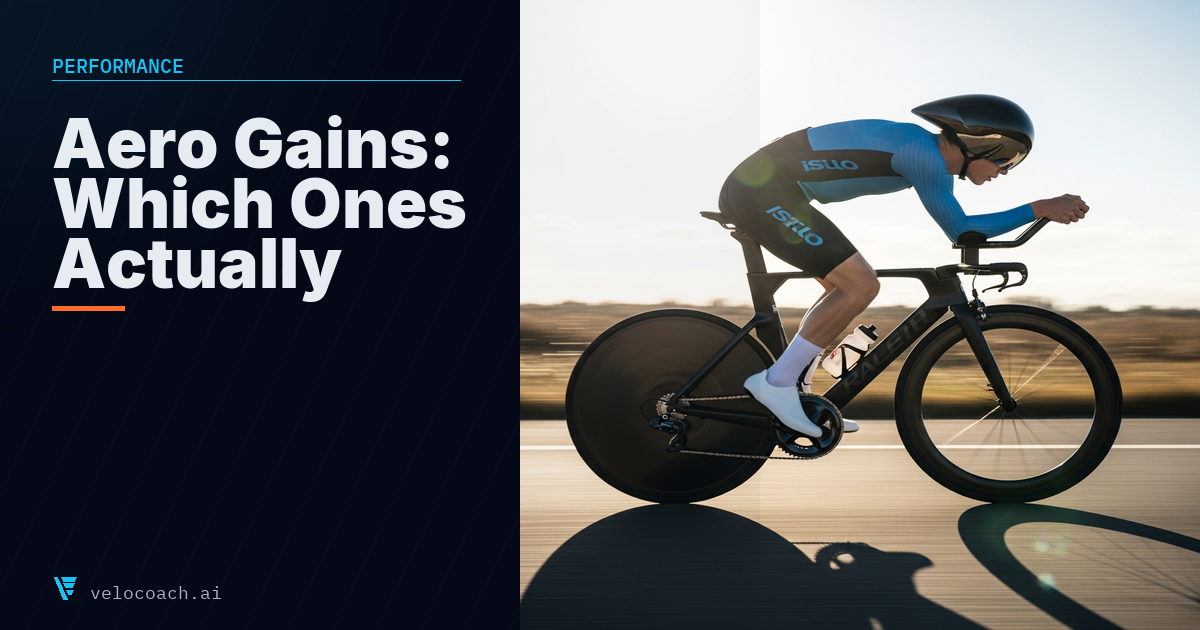
Aero Gains for Cyclists: The Marginal Gains That Actually Add Up
"Marginal gains" became a cycling cliché after Team Sky's success in the 2010s. The concept is sound: many small improvements, each negligible in isolation, accumulate into meaningful performance advantages. The problem is that the phrase has been attached to trivial or invented optimisations alongside genuinely impactful ones.
For amateur road cyclists, identifying which aerodynamic gains are worth the cost and effort requires understanding the underlying physics and the real-world magnitude of each intervention.
The Physics of Aerodynamic Drag
Aerodynamic drag force increases with the square of speed. At 30 km/h, drag is modest. At 45 km/h, drag is more than twice as high per unit of distance. At 50 km/h, it is more than three times higher.
This means aerodynamic optimisation has increasing return as speed increases. At slow speeds (climbing, soft-pedalling), drag is a minor factor. At high sustained speeds (flat time trials, fast group rides, descents), drag is the dominant resistance force.
The power required to overcome aerodynamic drag is proportional to speed cubed. Going from 40 km/h to 44 km/h (10% faster) requires approximately 33% more power just for aerodynamic resistance, all other things being equal. Reducing drag is a more power-efficient way to go faster than increasing wattage.
Body Position: The Biggest Gain Available
Position is the most impactful aerodynamic variable for most cyclists, and it costs nothing but flexibility and adaptation time.
Research using computational fluid dynamics and wind tunnel testing consistently finds that the rider's body accounts for 70 to 80% of total aerodynamic drag in a typical road cycling position. The bike, wheels, and components account for the remaining 20 to 30%.
This has a practical implication: expensive aerodynamic components produce modest drag reductions on top of a large base value (the rider). Improving the rider's position produces drag reductions from the largest contributor.
Head position: Tucking the chin toward the chest and keeping the head low and in line with the spine reduces frontal area significantly. Riders who ride with their head raised substantially into the wind create a notable drag penalty.
Elbow width: Narrower elbows reduce frontal area. Bringing elbows inward from a wide position can produce drag reductions of 5 to 15% without any equipment change.
Back flatness: A flatter back reduces the frontal and projected area. This requires hip flexor flexibility and a position that supports it. An aggressive fit without the flexibility to hold the position is counterproductive.
Hand position: Riding on the hoods versus on the drops produces measurable drag difference. Drops are more aerodynamic; the magnitude depends on how much your back angle and torso position change between the two.
In wind tunnel testing, rider position changes of the type an amateur cyclist can make (head position, elbow width, torso angle) routinely produce time savings of 30 to 90 seconds per hour at 45 km/h. No equipment upgrade produces gains of this magnitude.
Helmet
Aerodynamic helmets produce real, measured gains. A well-fitted aero road helmet (Kask Utopia, Giro Aerohead, Smith Prevail TT) saves 10 to 20 seconds per hour at 45 km/h compared to a standard road helmet, according to independent testing.
The key qualifier is "well-fitted." An aero helmet that does not match your head shape or sit correctly on your head, or one that requires you to hold an uncomfortable head position to close the tail, produces smaller real-world gains than its wind tunnel numbers suggest.
For most amateur road cyclists, an aero helmet is one of the more cost-effective aerodynamic upgrades available. Prices start at around £150 for genuine aero performance.
Clothing
Skin suits (one-piece tight-fitting garments) versus standard road kit (bib shorts and jersey) produce measurable drag differences. In wind tunnel studies, a well-fitted skin suit saves 30 to 60 seconds per hour compared to standard baggy road kit.
The degree of gain from clothing depends heavily on how well your standard kit fits. A loose jersey flapping in the wind produces enormous drag. A well-fitted, form-hugging jersey reduces the gain from a skin suit to perhaps 20 to 30 seconds per hour.
For time trials, skin suits are the standard choice for any serious competitor. For road racing and sportives, a well-fitted jersey and bib shorts are a reasonable compromise between aerodynamics and comfort over long distances.
Socks: Tall cycling socks (15 to 20cm above the ankle) have been shown in some studies to produce small drag reductions compared to ankle-height socks. The magnitude is small (seconds per hour) but measurable. High cycling socks are legitimate aerodynamic clothing.
Wheels
Aerodynamic wheels are one of the most marketed cycling products. The actual gains are real but context-dependent.
Deep-section carbon wheels (50mm+ depth) produce less drag than shallow box-section aluminium wheels at flat-road speeds above 35 km/h. The drag saving is primarily from the wheel's airfoil profile reducing the rotational aerodynamic losses.
Real-world time savings from deep carbon wheels versus standard aluminium wheels in flat time trial conditions: 30 to 60 seconds per hour at 45 km/h, per testing from independent organisations (Wheel Energy, Tour magazine).
Limitations: deep wheels are significantly less stable in crosswinds, are heavier than the lightest climbing wheels, and cost £1,000 to £4,000+ for quality options. The return on investment compared to body position optimisation (free) or an aero helmet (£150 to £300) is poor for most amateur cyclists.
Prioritising Your Aero Investment
A practical priority hierarchy for amateur cyclists:
- Body position (free): Biggest available gain. Work on flexibility, head position, and elbow width.
- Well-fitted clothing (£50 to £200): A form-fitting jersey and bib shorts significantly reduce clothing drag versus loose kit.
- Aerodynamic helmet (£150 to £300): Meaningful, measurable gain per pound spent.
- Shoe covers or aero socks (£20 to £60): Small gain, low cost.
- Aero wheels (£500 to £3,000+): Real but expensive. Worthwhile for serious time trialists or racers; poor value for most sportive cyclists when compared to the options above.
The lesson from the marginal gains philosophy is not "buy every aero product." It is "measure your gains and prioritise the best return per pound and per hour."
---
Train with a coach that reads your data
VeloCoach AI connects to Garmin, Wahoo, Intervals.icu and Apple Health, and tells you exactly what to do next.
Download on the App Store