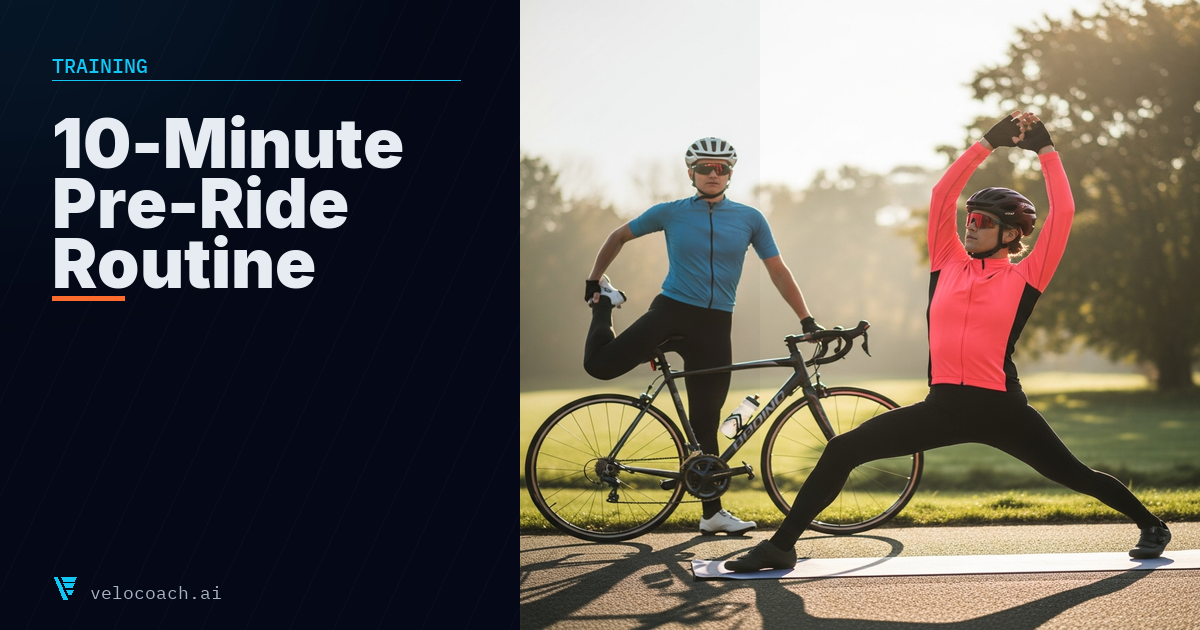
The Pre-Ride Activation Routine That Actually Works
Most cyclists warm up on the bike. A few easy minutes at low watts, gradually picking up to working pace. It feels adequate. For short sessions, it might be. But for rides that require maximal power from early on, for intervals, group rides, or races, an on-bike warm-up misses something the research consistently shows matters: getting the right muscles primed before you even put your foot on the pedal.
An off-bike activation routine serves two purposes. The first is neuromuscular: it establishes the neural patterns for muscle recruitment that will be needed during the session. The second is structural: it takes the key joints through ranges of motion that cycling itself does not access, reducing injury risk and improving comfort in the riding position.
This routine takes ten minutes. The difference it makes in the first twenty minutes of a hard session is noticeable within two or three weeks of consistent use.
Why Warm-Up Quality Matters
Power output at the beginning of a ride depends heavily on muscle temperature and neuromuscular readiness. Research on dynamic warm-up protocols consistently shows that athletes who perform structured activation work before hard sessions produce higher peak power in early efforts and sustain higher power through the session compared to athletes who warm up passively or on the bike alone.
The specific mechanism for cyclists: glute activation. As covered in a separate post, cycling relies heavily on the gluteal muscles but does not naturally prime them. Sitting at a desk all day before a training session leaves the glutes inhibited. An on-bike warm-up at easy watts does not create the hip extension range or the single-leg loading needed to switch them on. A structured activation routine does.
Studies tracking glute EMG activity in cyclists found 8 to 12% higher glute activation during threshold efforts when athletes completed a structured pre-ride activation protocol compared to rides that started cold.
The 10-Minute Activation Routine
Work through these exercises in sequence. Keep transitions quick. This is activation, not stretching. The movements should be controlled but have some energy to them.
1. Leg Swing: 20 reps each leg (front to back, then side to side) Stand on one leg and swing the other freely forward and back through a full range. Then switch to lateral swings, crossing in front of the standing leg and then out to the side. These dynamic swings take the hip through the range of motion it will need during the ride and warm up the hip flexors, glutes, and adductors simultaneously. No holding required. Just swing with control.
2. Glute Bridge: 2 sets of 15 reps On your back, knees bent, feet flat. Drive through the heels, lift the hips to a straight line from knees to shoulders, squeeze the glutes at the top for a full second, lower with control. Keep the pace deliberate, not rushed. This is the foundational activation exercise that primes the basic glute firing pattern.
3. Clamshell: 2 sets of 15 each side Lie on your side with knees bent at 90 degrees. A resistance band just above the knees adds meaningful resistance. Rotate the top knee toward the ceiling, keeping feet together, then lower with control. The glute medius, which stabilises the knee during the pedal stroke, is the target here. If you have persistent knee pain on the bike, this exercise is particularly important.
4. Hip Flexor Lunge (Dynamic): 10 reps each side Step forward into a lunge, lower the back knee close to the floor, then push back to standing. No holding. The dynamic version of the kneeling hip flexor stretch primes the hip flexors through movement rather than lengthening them passively, which is more appropriate before a hard session.
5. Single-Leg Deadlift: 10 reps each side Stand on one leg, hinge forward at the hip (not the lower back), extend the non-standing leg behind you for balance, until you feel a light stretch in the hamstring, then return to standing. This activates the posterior chain, particularly the glutes and hamstrings, through hip extension, closely mirroring the downstroke mechanics of the pedal stroke.
6. Thoracic Rotation: 10 reps each side Sit on the floor with knees bent (or kneel on all fours). Rotate the upper body as far as comfortable to one side, reaching the top arm toward the ceiling. Return and repeat to the other side. Cycling locks the thoracic spine in flexion. Opening it up pre-ride reduces shoulder and upper back discomfort and allows a more comfortable aero position.
7. Ankle Circles: 10 each direction, each ankle Simple but worth doing. Ankle mobility directly affects the quality of the pedal stroke at the bottom of the rotation. Stiff ankles produce a less efficient power transfer and put additional load on the calf and Achilles.
After the Activation: The On-Bike Warm-Up
The activation routine is followed, not replaced, by the on-bike warm-up. After the 10 minutes of activation, clip in and ride at a genuinely easy pace (Zone 1, below 55% FTP) for 10 to 15 minutes. This raises core temperature, increases blood flow to the working muscles, and allows a final adjustment to the riding position.
For sessions involving high-intensity work, add a few progressive efforts in the final five minutes of the warm-up: 10 to 20-second efforts at increasing intensity, up to the level you will be working at in the session. These neuromuscular primers further prepare the body for high-output work.
The total warm-up investment before a quality session: approximately 20 to 25 minutes. Athletes who feel pressed for time often try to compress this. The data suggests that is one of the worst places to cut time. Session quality in the first third of a workout is significantly better with a proper warm-up, and session quality determines adaptation.
For Races Specifically
The pre-race warm-up follows the same structure but with more emphasis on the progressive on-bike efforts and less emphasis on the mobilisation work. A race-morning activation routine of the glute bridge and clamshell (5 minutes) followed by a 20-minute progressive on-bike warm-up ending with two or three 15 to 20-second hard efforts is a solid standard protocol for road racing.
Arrive at the start warm and with your neuromuscular system already primed. The first hard effort in a race should not feel like a shock. It should feel like continuation.
---
Train with a coach that reads your data
VeloCoach AI connects to Garmin, Wahoo, Intervals.icu and Apple Health, and tells you exactly what to do next.
Download on the App Store