Core Training for Cyclists That Actually Works
"You need to do more core work." Cyclists hear this constantly, and most of them know it. Many have tried it, done a few weeks of sit-ups or planks, noticed no difference on the bike, and quietly abandoned it.
The problem is not that core training does not matter for cycling. It is that most cyclists are doing the wrong kind of core training in the wrong way, for reasons that make sense on a gym floor but do not translate to the bike.
What "Core" Actually Means for Cyclists
The core, anatomically speaking, is not just the abdominals. It is the cylinder of muscles surrounding the trunk: the deep spinal stabilisers (multifidus, erector spinae), the diaphragm at the top, the pelvic floor at the bottom, and the transverse abdominis wrapping around the middle. On top of these deep stabilisers sit the more superficial global muscles, including the rectus abdominis, obliques, and gluteal muscles.
For cyclists, the relevant function of this system is not movement but stability. You are not generating force through your trunk. You are keeping your trunk stable so that leg force can transfer efficiently to the pedals without energy leaking through a collapsing or rotating spine.
The practical failure of sit-ups and crunches for cyclists is that they train spinal flexion (bending forward). A cyclist's core needs to resist spinal flexion and rotation under load. Training the wrong movement pattern does not carry over.
Why Core Stability Matters on the Bike
A stable trunk serves cycling performance in two specific ways.
First, force transfer. Every watt of leg power travels from your legs through your pelvis and trunk to the handlebars and cranks. A core that cannot hold position under that force absorbs some of it as movement rather than transmitting it to the drive train. Research estimates that core instability can reduce power transfer efficiency by 8 to 12% in cyclists with measurable instability problems.
Second, positional sustainability. As fatigue accumulates in a long ride, the first place many cyclists lose form is the trunk. Hips drop and rotate, the spine rounds, and the pelvis tilts in ways that reduce glute recruitment and increase hip flexor strain. A stronger, more endurance-capable core holds position longer, preserving both efficiency and injury resistance deep into long rides.
The Evidence on Core Training for Cyclists
A 2024 randomised controlled trial in the Journal of Strength and Conditioning Research tested eight weeks of cycling-specific core training against a control group in trained cyclists. The intervention group improved their 40km time trial performance by 2.1% on average and showed significant improvements in trunk endurance measures. The control group showed no significant change. Power output at VO2 max also improved slightly in the core group, attributed to improved force transfer efficiency.
A 2023 systematic review in Sports Medicine found that core stability interventions in endurance athletes consistently reduced lower back pain (which affects 58-68% of road cyclists) and improved economy, defined as power output per unit of oxygen consumed, in 7 of 9 studies reviewed.
What Core Training for Cyclists Should Look Like
Prioritise anti-movement over movement. The exercises that transfer best to cycling train the core's ability to resist forces, not create them. The key categories:
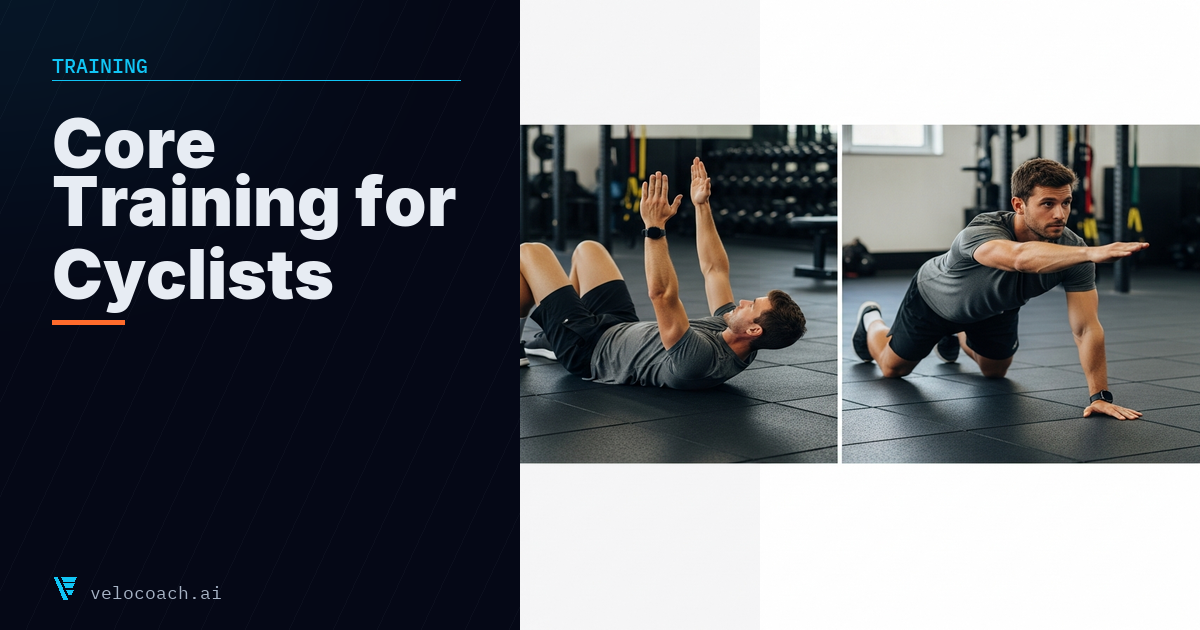
Anti-extension: Preventing the lower back from arching under load. - Dead bug: lying on your back, lower one arm and the opposite leg simultaneously while keeping the lower back pressed flat. Start with 3 sets of 8 per side. - Ab wheel rollout: from knees initially. One of the highest-activation anti-extension exercises available.
Anti-rotation: Preventing the trunk from twisting under load. - Pallof press: with a resistance band or cable, press and hold straight out from the chest against the pull of the band. The challenge is resisting, not moving. - Single-arm plank variations: introduces rotational challenge to a familiar exercise.
Anti-lateral-flexion: Preventing the spine from bending sideways (critical for hip drop on the bike). - Side plank and Copenhagen plank variations. - Suitcase carry: walking with a heavy weight in one hand only.
Hip-trunk integration: Training the connection between the glutes and trunk stability. - Bird-dog: on hands and knees, extend opposite arm and leg while keeping the trunk perfectly still. - Single-leg RDL with trunk bracing: integrates glute loading with spinal stability under a meaningful load.
The Cycling Position Connection
One important point most core programmes miss: core training should be partly position-specific. Training exclusively upright does not fully prepare the core for the sustained hip flexion of the cycling position.
Progress exercises toward the demands of cycling: - Perform some dead bug variations with the hip at roughly cycling position angles. - Add prone holds over a stability ball that approximate the trunk angle on the bike. - Plank variants with a slight forward lean (closer to hoods or drops position) rather than flat.
This does not mean all exercises need to mimic cycling. But bridging the movement pattern helps transfer.
How to Programme It
For most road cyclists, 2-3 dedicated core sessions per week of 15-20 minutes each is sufficient. Doing more does not produce proportionally more benefit. Core endurance rather than peak strength is the goal, so longer holds and higher rep counts at moderate difficulty outperform low-rep maximum-load approaches.
Place core sessions either: - After an easy ride (convenient, does not compromise the main session) - On rest or active recovery days (keeps them genuinely separate from quality ride work) - Before strength training in the gym (core pre-activation improves subsequent compound lift stability)
Do not perform intense core work before a quality cycling session. Fatiguing your trunk stabilisers immediately before a threshold or VO2 max session impairs both safety and performance.
A minimal effective programme for a time-pressed cyclist: - Dead bug: 3 sets of 10 per side - Side plank: 3 x 30-40 second holds per side - Bird-dog: 3 x 10 per side - Pallof press: 3 x 10 per side
That is 15 minutes, 3 times a week. Research supports this volume producing meaningful transfer to cycling performance and injury reduction.
---
Train with a coach that reads your data
VeloCoach AI connects to Garmin, Wahoo, Intervals.icu and Apple Health, and tells you exactly what to do next.
Download on the App Store