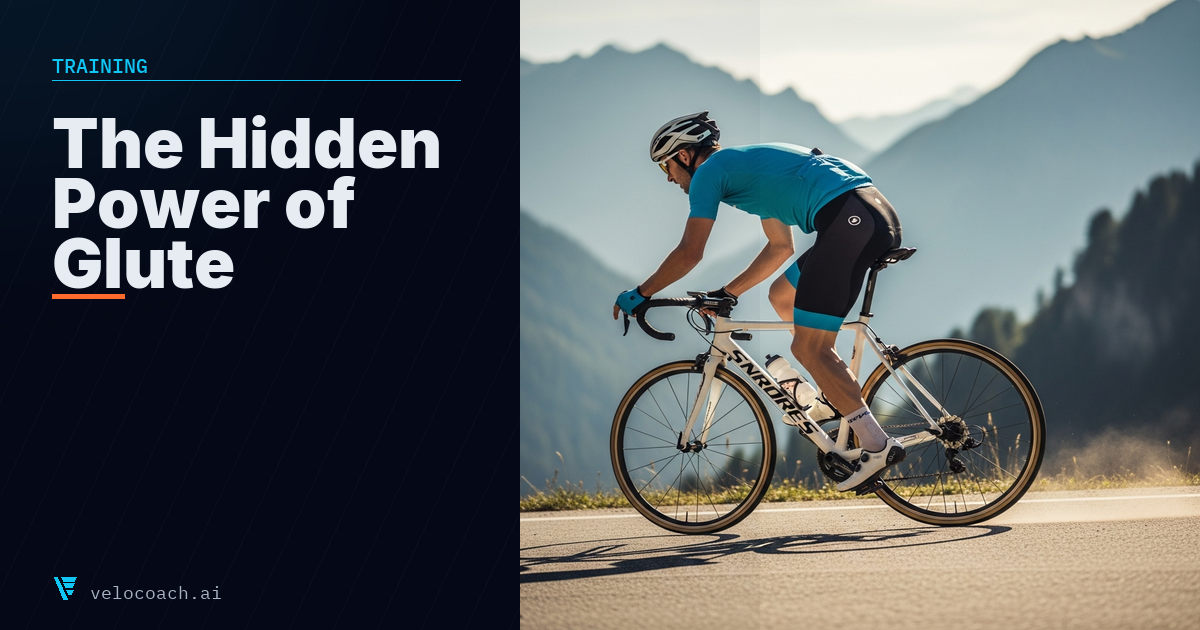
The Glute Activation Routine Every Cyclist Should Do Before They Ride
Your glutes are the most powerful muscle group in your body. They are also, for many cyclists, almost completely switched off by the time you clip in.
That's not an exaggeration. Research consistently shows that cyclists with desk jobs, or anyone who sits for more than a few hours a day, develop inhibited gluteal muscles. The hip flexors shorten and tighten. The glutes, which are supposed to work in opposition, gradually stop firing the way they should. The result is that during your ride, your quads and hamstrings pick up the slack, your pedal stroke becomes less efficient, and you leak watts you didn't know you had.
The fix is simple, takes under ten minutes, and has solid evidence behind it. Here's why it matters and exactly what to do.
Why Cyclists Lose Glute Function
Cycling involves repeated hip flexion. Your pedal stroke takes the hip through roughly 90 degrees of movement, and that movement is almost entirely in the flexion direction. You flex the hip, the quad contracts, the glute extends, and you repeat that 5,000 times on a two-hour ride.
The problem is that cyclists rarely take the hip through full extension. Unlike running, where you push behind your body with a powerful glute drive, cycling keeps the hip in a relatively small range. The glute never gets the full contraction signal it needs to stay neurologically primed.
Combine that with six to eight hours a day sitting at a desk, and you have a pattern of chronic hip flexor shortening that actively competes with glute function. When the hip flexors are tight, they tilt the pelvis forward, which places the glutes at a mechanical disadvantage. The nervous system begins to down-regulate their recruitment. Cyclists call this "glute amnesia." The muscles are not damaged. They have simply learned not to show up.
A 2025 meta-analysis in the European Journal of Applied Physiology reviewed 17 studies covering 262 cyclists and found that targeted strength training significantly improved cycling efficiency, anaerobic power, and time trial performance. The mechanism? Improved neuromuscular recruitment, including more consistent glute activation during pedalling.
The practical implication: training your glutes to fire before you ride makes a measurable difference to the power you actually produce.
What Happens When Glutes Don't Fire
The effects cascade through your whole body:
Power output drops. The glutes contribute significantly to hip extension during the downstroke. If they are not recruited, the quads compensate, which is less efficient and creates more metabolic cost per watt.
Knees suffer. Without proper glute medius function, the knee tracks inward during pedalling. This is one of the most common causes of anterior knee pain in cyclists. The problem is not the knee. It is what is not happening at the hip.
Lower back takes the strain. Pelvic instability from weak glutes means the lumbar spine absorbs forces it shouldn't. Many cyclists who report chronic lower back pain during long rides find significant relief once they address glute function.
Fatigue comes earlier. When your primary movers are not firing optimally, secondary muscles compensate and fatigue faster. A properly activated glute system lets you sustain higher power for longer.
What the Research Says About Pre-Ride Activation
A study tracking cyclists with and without pre-ride glute activation found 8-12% higher glute EMG activity during threshold efforts when the athletes completed activation work first. That's not a small margin. For a rider averaging 280 watts, that could represent meaningful additional power delivered more efficiently over the course of a long race or hard training session.
The exercises with the highest glute EMG are not crunches or machine-based movements. Hip thrusts, Romanian deadlifts, single-leg glute bridges, and clamshells with resistance band consistently produce the highest activation signals in research. The pre-ride routine draws from these.
The 8-Minute Pre-Ride Routine
You don't need a gym or equipment for most of this. A resistance band for the clamshells helps, but everything else is bodyweight.
1. Glute Bridge: 2 sets of 15 reps Lie on your back, feet flat on the floor, hip-width apart. Drive through your heels to lift your hips until your body forms a straight line from knees to shoulders. Squeeze at the top for a full second. Lower with control. This wakes up the basic glute firing pattern.
2. Clamshell with Band: 2 sets of 15 each side Lie on your side with knees bent and a resistance band just above your knees. Keep your feet together and rotate your top knee toward the ceiling, squeezing the glute medius at the top. This is the exercise that addresses the knee-tracking problem. Do both sides.
3. Hip Flexor Lunge Stretch: 45 seconds each side Kneel with one knee on the floor, the other foot forward. Tuck your pelvis under slightly and drive forward until you feel a stretch in the front of the hip on the trailing leg. Hold for 45 seconds. This releases the antagonist before you ask the glute to fire against it.
4. Single-Leg Glute Bridge: 2 sets of 10 each side Same setup as the standard bridge, but with one leg raised. This brings more demand onto each glute individually and better mirrors the single-leg nature of cycling.
5. Lateral Band Walk: 10 steps each direction Band around your ankles or just above the knee. Slight knee bend, feet hip-width apart. Step sideways maintaining tension on the band throughout. This activates the glute medius and minimus, which stabilise the pelvis during the pedal stroke.
Do this routine consistently before every ride for two to three weeks and notice the difference. Many cyclists report their saddle feel changes, because they are sitting more through their glutes than their hamstrings. They also notice more power on climbs where the glute contribution is highest.
Making It a Habit
The barrier to this routine is not difficulty. It is discipline. You're standing next to your bike, already in kit, ready to ride. Adding ten minutes of floor exercises feels tedious when you have a specific window to train.
The reframe that helps: this is the first ten minutes of your session, not a delay before it. Your ride starts here. The data backs it up.
If you are using VeloCoach, your training load data will show you whether your power output is consistent with your current Fitness. If your numbers are systematically lower than they should be for your fitness level, weak glute recruitment is one of the first places to look.
---
Train with a coach that reads your data
VeloCoach AI connects to Garmin, Wahoo, Intervals.icu and Apple Health, and tells you exactly what to do next.
Download on the App Store