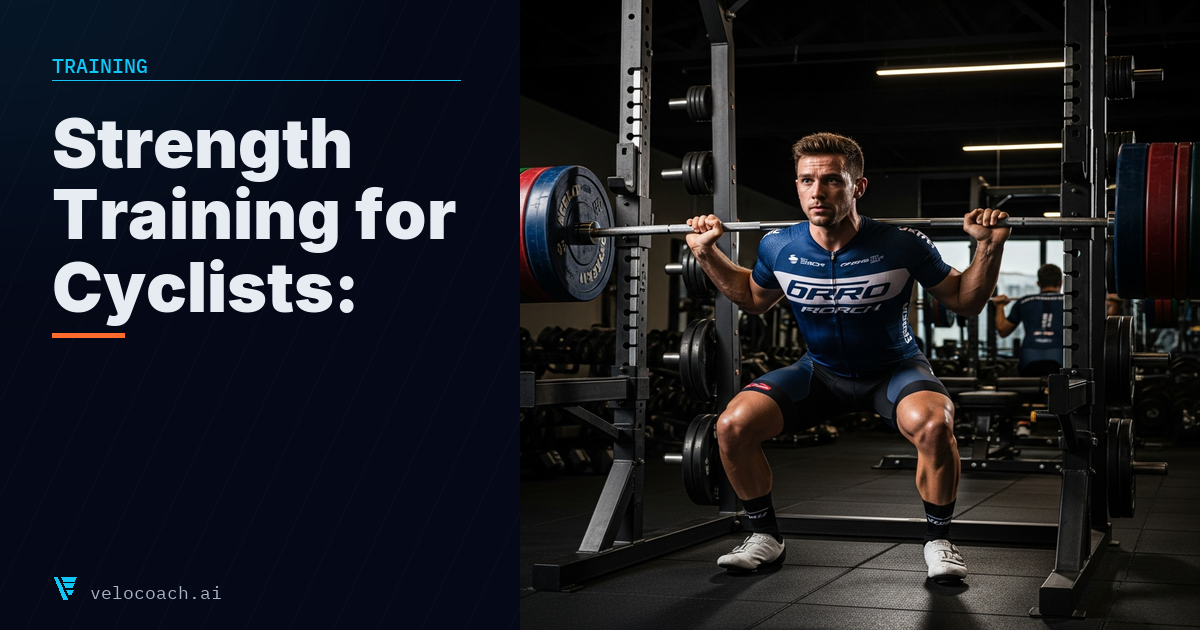
The Gym Programme Cyclists Actually Need (And It's Not What You Think)
Most cyclists who lift weights are doing it wrong. Not dangerously wrong. Just inefficiently wrong, in a way that leaves most of the potential benefit on the table.
The usual mistakes: lots of machine work, high-rep low-weight circuits, foam rolling routines dressed up as strength training, and a general avoidance of anything that looks like a powerlifting exercise. The reasoning goes that heavy lifts might make you bulky, and cyclists do not want to carry extra mass.
The research does not support this fear. What it does support, clearly, is that heavy resistance training makes cyclists faster, improves economy, and increases time-trial performance, without meaningfully increasing body mass in trained athletes who are not in a caloric surplus.
Here is what the evidence actually shows and what a practical programme looks like.
What the Research Says
A 2025 meta-analysis in the European Journal of Applied Physiology reviewed 17 studies covering 262 cyclists and found that heavy strength training significantly improved cycling efficiency, anaerobic power, and time trial performance. The key word is heavy. Not machine-based circuit training, not bodyweight work, not cycling-specific resistance bands. Heavy compound lifts.
The mechanisms are well understood. Cycling is a high-repetition, sub-maximal force activity. Every pedal stroke requires a certain percentage of your maximal muscular force. If you increase your maximum force capacity through strength training, each pedal stroke requires a lower percentage of that capacity. The result is improved cycling economy, the amount of energy required to maintain a given power output. You go further on the same fuel.
Additional benefits documented in the research: - Improved neuromuscular recruitment patterns, including better glute activation - Increased type I to type II fibre ratio in some protocols, improving fatigue resistance - Reduced injury incidence from stronger supporting musculature around the hip, knee, and lower back - Better power delivery in short, hard efforts from increased maximal force expression
One frequently cited case study reported that an athlete added approximately 10W to an all-time FTP following a 12-week strength training block. That is a meaningful number from a modest time investment.
What "Heavy" Actually Means for Cyclists
Heavy strength training for cyclists does not mean maxing out every session or training to build a bodybuilder physique. It means lifting at 75 to 90% of your one-rep maximum for 3 to 6 repetitions per set. This is the intensity range that produces maximal neural drive and the neuromuscular adaptations most relevant to cycling.
Compare this to the 12-to-15-rep circuit work many cyclists default to. High-rep, lower-weight training produces mostly local muscular endurance adaptations. Cyclists already have substantial local muscular endurance from riding. They do not need more of it from the gym. They need maximal force and neuromuscular efficiency.
The Programme
Two sessions per week is sufficient for most cyclists to see meaningful strength gains while managing the fatigue impact on cycling training. Session duration is 45 to 60 minutes including warm-up. The programme below covers the key movements.
Session A
Back Squat or Goblet Squat: 4 sets of 4-6 reps at 80% 1RM The most effective overall lower body strength exercise. The back squat loads the glutes, quads, and hamstrings simultaneously. If you lack the mobility for a back squat, start with a goblet squat or a trap bar deadlift instead.
Romanian Deadlift: 3 sets of 5 reps Primary posterior chain stimulus. Trains the glutes and hamstrings through hip extension, which directly mirrors the downstroke mechanics of cycling. Also develops the thoracic extensors needed for riding position.
Single-Leg Press: 3 sets of 8 each side Cycling is a single-leg activity. Adding single-leg loading catches asymmetries and builds cycling-specific strength patterns. Keep the weight moderate enough to control the movement throughout.
Session B
Deadlift: 4 sets of 4-5 reps at 80% 1RM Total posterior chain loading. The deadlift produces some of the highest glute and hamstring activation of any exercise and builds the foundational strength that transfers to everything else.
Bulgarian Split Squat: 3 sets of 6 each side One of the most cycling-specific strength exercises available. The single-leg loading, split position, and hip extension demand closely mirror what happens on the bike. Also excellent for identifying and correcting left-right strength imbalances.
Hip Thrust: 3 sets of 10 reps The exercise that produces the highest glute EMG of any movement. Where the squat builds glute strength through a knee-dominant pattern, the hip thrust builds it through pure hip extension. Both are worth doing.
Core: Dead Bug or Pallof Press: 3 sets of 10-12 reps Cycling-specific core work is about resisting rotation and maintaining a stable pelvis under load, not crunches. The dead bug (lying on your back, extending opposite arm and leg while keeping the lower back flat) is excellent for this.
When to Lift in Your Training Week
Timing matters. Strength sessions create fatigue that affects quality on the bike for 24 to 48 hours. Plan sessions so they fall on days that precede easy riding days, not before key bike sessions.
A practical structure: - Monday: strength session A - Tuesday: Zone 2 ride or rest - Wednesday: quality bike session (intervals) - Thursday: strength session B - Friday: rest or very easy ride - Saturday: long ride - Sunday: rest or easy ride
During peak training blocks and in the two to three weeks before a target race, reduce or remove strength training to allow full recovery. The strength you have built will not disappear in three weeks.
The Off-Season Versus In-Season Approach
The off-season is the ideal time to build strength. Without racing commitments, you can tolerate the additional fatigue from higher-volume strength work. A three-phase off-season programme works well:
- Weeks 1-4: adaptation phase (3x12 reps, lighter weights, focus on movement quality)
- Weeks 5-10: strength phase (4x5 reps, heavy loads, full expression of the protocol above)
- Weeks 11-14: power phase (3x4-6 reps at 80-85% 1RM, faster concentric movement to develop power expression)
In season, reduce to maintenance. Two sessions of 2x5 on key compound lifts is usually enough to hold your strength gains through the racing season.
---
VeloCoach has strength sessions built in
Gym sessions built for cyclists, scheduled into your week by the same coach that plans your riding. Every lift explains why you are doing it.
See the strength sessions →