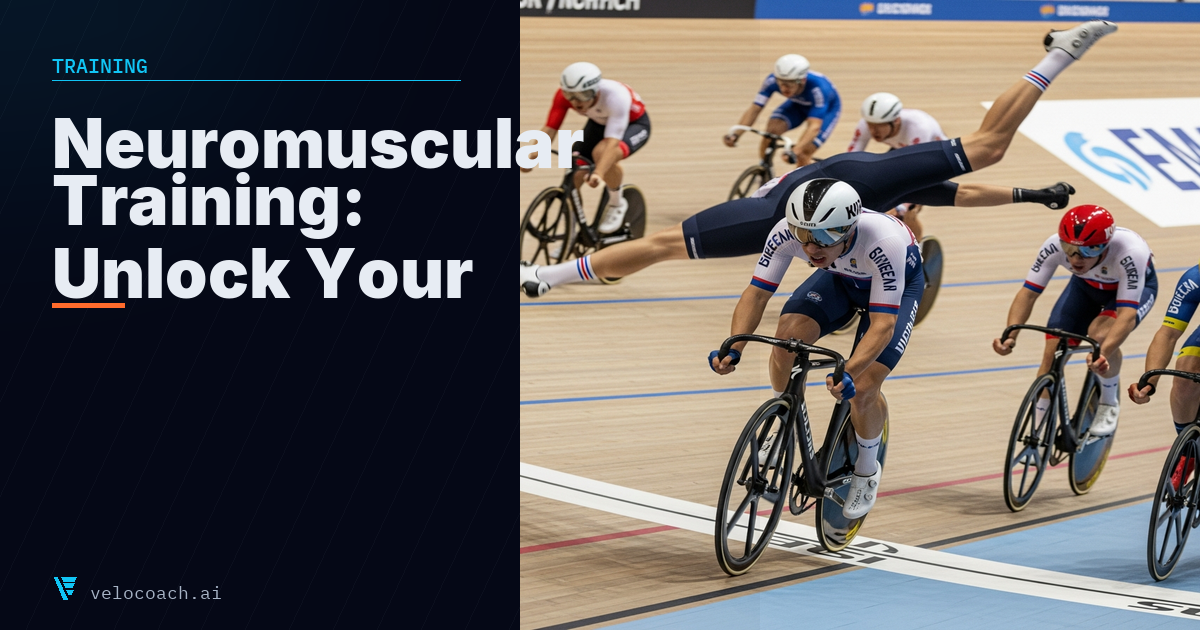
Neuromuscular Training for Cyclists: The Power Nobody Trains For
Most cyclists train their aerobic system thoroughly. Zone 2 for the base. Threshold for the engine. VO2 max for the ceiling. This covers the majority of what determines cycling performance, and if you are only doing these things, your training programme is reasonably sound.
But there is a third dimension of cycling performance that the aerobically focused programme misses almost entirely: neuromuscular power. And if you have ever been dropped on a short, punchy climb, lost a sprint despite having good aerobic fitness, or struggled to respond when the pace suddenly jumped, you know the gap it leaves.
What Neuromuscular Training Is
Neuromuscular power refers to the ability to produce very high force very quickly. It is governed primarily by the nervous system: how fast neural signals reach muscles, how many motor units are recruited simultaneously, and how explosively the muscle fibres contract.
At intensities above approximately 120% of FTP, the aerobic system can no longer supply energy fast enough to meet the demand. Energy comes increasingly from the phosphocreatine system (very short, explosive efforts) and anaerobic glycolysis (hard efforts lasting 30 seconds to two minutes). These systems are trained differently from the aerobic system, and training them produces different adaptations.
The cycling situations where neuromuscular power determines the outcome: - Attacks and counter-attacks in road races - Short punchy climbs (under 90 seconds) - Sprint finishes - Getting out of corners in criteriums - Responding to sudden pace increases in group rides - Road surface acceleration over rough patches
An athlete with excellent aerobic fitness but poor neuromuscular capacity can sustain 5 watts per kilogram for hours and still lose on a 60-second hill because they simply cannot produce the instantaneous force required to stay with a surge.
The Physiology Behind It
Neuromuscular adaptations from specific training include:
Increased motor unit recruitment. In explosive efforts, training increases the percentage of available muscle fibres that are simultaneously activated. Untrained athletes recruit a smaller fraction of available motor units even at maximum effort.
Faster rate coding. Neural signals arrive at muscles faster and more frequently in trained athletes. This produces faster force development, which is what makes the initial acceleration feel "explosive."
Improved inter-muscular coordination. Explosive efforts require multiple muscle groups to fire in the right sequence at the right time. Training this pattern makes the movement more efficient.
Phosphocreatine system capacity. Very short maximum efforts (3-10 seconds) deplete phosphocreatine stores. Training at this intensity increases creatine kinase activity and PCr replenishment rate.
The Workouts
Neuromuscular training requires near-maximum effort for very short durations with complete recovery. The key principle is quality over quantity: these sessions should not accumulate fatigue, they should develop explosive capacity.
Sprint efforts: 6-10 seconds at maximum Ride to a good road with a slight tailwind if possible. From a moving start in a moderate gear, accelerate maximally for 8 seconds. Recover for 3-5 minutes of easy riding before the next effort. Aim for 6-10 repetitions.
The purpose is pure neuromuscular development. The recovery must be complete. If you are still breathing hard when you start the next effort, the recovery is too short.
Standing starts: 5-8 seconds From a near-stationary position in a big gear, accelerate from almost zero to maximum speed. This develops explosive leg drive from low speed, which is the exact demand of attacking out of a corner or cresting a short climb.
High-cadence spin-ups: 20 seconds In a light gear, spin cadence up progressively until you cannot increase it further. No power target. Focus on removing "dead spots" from the pedal stroke at high rotational speed. These develop pedal stroke smoothness at high cadence, which becomes important in sprint situations.
30-second max efforts Longer than the pure sprint work, 30-second efforts train the transition between phosphocreatine and anaerobic glycolysis. From a controlled effort, accelerate to maximum and sustain it for the full 30 seconds. Full recovery (5-7 minutes) between repetitions.
When to Include Neuromuscular Work
Neuromuscular sessions fit naturally at the start of any ride when the legs are fresh, because the quality of explosive efforts degrades significantly with accumulated fatigue. A 20-minute activation ride followed by sprint efforts is a perfectly valid session format.
Year-round inclusion is appropriate: 1 to 2 neuromuscular sessions per week, each containing 6 to 10 short efforts, adds meaningful explosive capacity without significant fatigue cost. The sessions are short (30-45 minutes total) and recovery is relatively rapid.
Increase the emphasis on neuromuscular work in the 4 to 6 weeks before events that require repeated hard accelerations. Reduce it in the deepest base-building phases where the priority is aerobic volume.
What Neuromuscular Training Does Not Do
It does not build aerobic fitness. Neuromuscular sessions are too short to produce meaningful cardiovascular adaptations. They should complement aerobic training, not replace any of it.
It does not directly increase FTP. Threshold power is an aerobic adaptation. Neuromuscular training improves your ability to produce very high power briefly, which matters in race scenarios but does not raise the sustained power ceiling.
It does, however, improve the economy of aerobic efforts by making the neuromuscular system more efficient, and it develops the ability to respond to attacks and produce accelerations that aerobically-focused training leaves undertrained.
---
Train with a coach that reads your data
VeloCoach AI connects to Garmin, Wahoo, Intervals.icu and Apple Health, and tells you exactly what to do next.
Download on the App Store