The Hip Flexor Problem Every Cyclist Has (And Most Ignore)
Lower back pain. Anterior knee pain. A pedal stroke that feels like you are pulling rather than driving. A persistent inability to get comfortable in the drops over long rides.
These are four different problems with one very common cause, and it lives in your hip flexors.
The hip flexors are a group of muscles that cross the front of the hip joint: the iliopsoas (the primary mover), the rectus femoris (part of the quadriceps group), the tensor fasciae latae, and a few smaller muscles. Their job is to flex the hip, bringing the knee toward the chest. On the bike, they are constantly active, pulling the knee up through the top of the pedal stroke.
The problem is not that cyclists use their hip flexors. It is that cyclists use them exclusively in a shortened position and almost never fully extend the hip to stretch them back out.
Why Cycling Creates Chronically Tight Hip Flexors
Running takes the hip through full extension with every stride. Walking does the same. Cycling does not. The geometry of the bike, particularly the degree of hip flexion at the bottom of the pedal stroke, keeps the hip flexors in a position where they never reach full extension. Combined with a crouched position on the bike, where the torso is forward, the hip flexors are essentially locked in a moderately shortened state for the entire ride.
Compound this with desk work. If you sit for six to eight hours before your ride, then ride for two hours, your hip flexors have been in a shortened position for nearly ten hours straight. The adaptive shortening that results is not subtle. Tight hip flexors are one of the most consistently identified findings in biomechanical assessments of cyclists.
A study published in the International Journal of Sports Physical Therapy found that a simple daily lunge-and-reach stretching intervention significantly improved both hip flexibility and gluteal function in subjects. The connection between tight hip flexors and inhibited glutes is direct: when the hip flexors are shortened, they create an anterior pelvic tilt that mechanically disadvantages the glutes, reducing their ability to fire effectively. Fix the hip flexors and glute activation often improves without any additional glute work.
What Tight Hip Flexors Do to Your Riding
Power loss. Full hip extension is necessary for complete glute engagement. Without it, you are producing less power per stroke than you should. Research from Physical Therapy in Sport found that cyclists with better hip joint mobility demonstrated significantly higher power output and mechanical efficiency. This is a direct data point, not a theoretical claim.
Lower back pain. Anterior pelvic tilt from tight hip flexors places increased compressive load on the lumbar spine. In the aero position, this is amplified by the forward lean. Many cyclists who report chronic lower back pain on rides over 90 minutes find the problem significantly reduced after eight to twelve weeks of consistent hip flexor stretching.
Anterior knee pain. The rectus femoris crosses both the hip and the knee. When it is chronically shortened, it pulls the patella upward and increases compressive forces at the front of the knee. This is a common source of the "knee cap pain" that cyclists experience on climbing efforts.
Reduced power at the top of the stroke. Tight hip flexors are also less efficient at the pull-through phase of the pedal stroke. If getting the knee up over the top feels laboured, the hip flexors may be the limiting factor.
The Daily 15-Minute Mobility Routine
Consistency matters more than duration. A 15-minute daily routine done every day produces better results than an occasional 60-minute session. Build this into your post-ride routine, when muscles are warm, or as a standalone session in the evening.
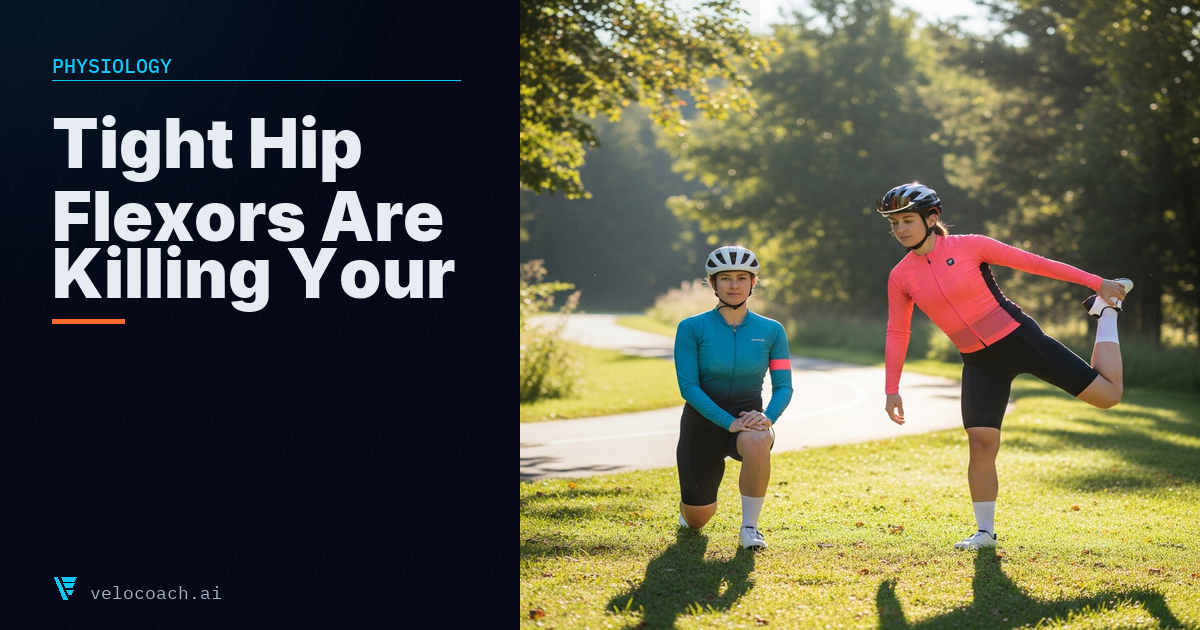
1. Kneeling Hip Flexor Stretch: 90 seconds each side Kneel with one knee on the floor, the other foot forward in a lunge position. Tuck the pelvis under (posterior tilt) and push the hips forward until you feel the stretch in the front of the hip on the trailing leg. For a deeper stretch, raise the arm on the same side as the back knee overhead and lean slightly away. This is the most important stretch in the routine. Give it full time on each side.
2. Pigeon Pose: 90 seconds each side From a press-up position, bring one knee forward and place the shin across the mat toward the opposite wrist. Extend the back leg behind you and sink the hips toward the floor. This addresses both the hip flexors and the external hip rotators (piriformis, gluteus medius), which are also chronically tight in cyclists. Work up to the full stretch gradually if this is new territory.
3. Standing Hip Flexor Stretch with Arm Reach (Lunge and Reach): 45 seconds each side Take a long lunge step forward. From the bottom of the lunge, raise both arms overhead and lean back slightly. This adds a thoracic extension component, countering the forward-flexed riding position. Based on the IJSPT research, this combined movement improves hip flexibility and glute function more effectively than the kneeling stretch alone.
4. Lying Quad Stretch: 60 seconds each side Lie face-down and pull one heel to the glute. This targets the rectus femoris, the part of the hip flexor group that also crosses the knee. Riders with anterior knee pain often find this stretch particularly effective.
5. 90/90 Hip Rotation: 10 reps each side Sit with both knees at 90 degrees, one in front and one to the side. Rotate between the two positions, switching the leading leg each time. This improves hip rotational mobility and the ability to find a neutral pelvis position on the bike.
Building It Into Your Week
The minimum effective dose for meaningful hip flexor improvement is daily stretching, but the rest day session is where the deepest work happens. On riding days, a 10-minute post-ride stretch session focusing on the kneeling hip flexor stretch and pigeon pose will make a significant difference over four to six weeks.
On rest days, take 30 to 45 minutes for the full routine above, along with any upper body mobility work your riding position demands.
Within six weeks of consistent work, most cyclists report a noticeable difference in riding comfort, particularly on rides over 90 minutes. The lower back discomfort reduces. The pedal stroke feels more fluid. The position in the drops becomes sustainable for longer.
If you are not already stretching, this is the single highest-return five minutes you can add to your training programme. Not the gym. Not more Zone 2. Hip flexor work, consistently, every day.
---
Train with a coach that reads your data
VeloCoach AI connects to Garmin, Wahoo, Intervals.icu and Apple Health, and tells you exactly what to do next.
Download on the App Store