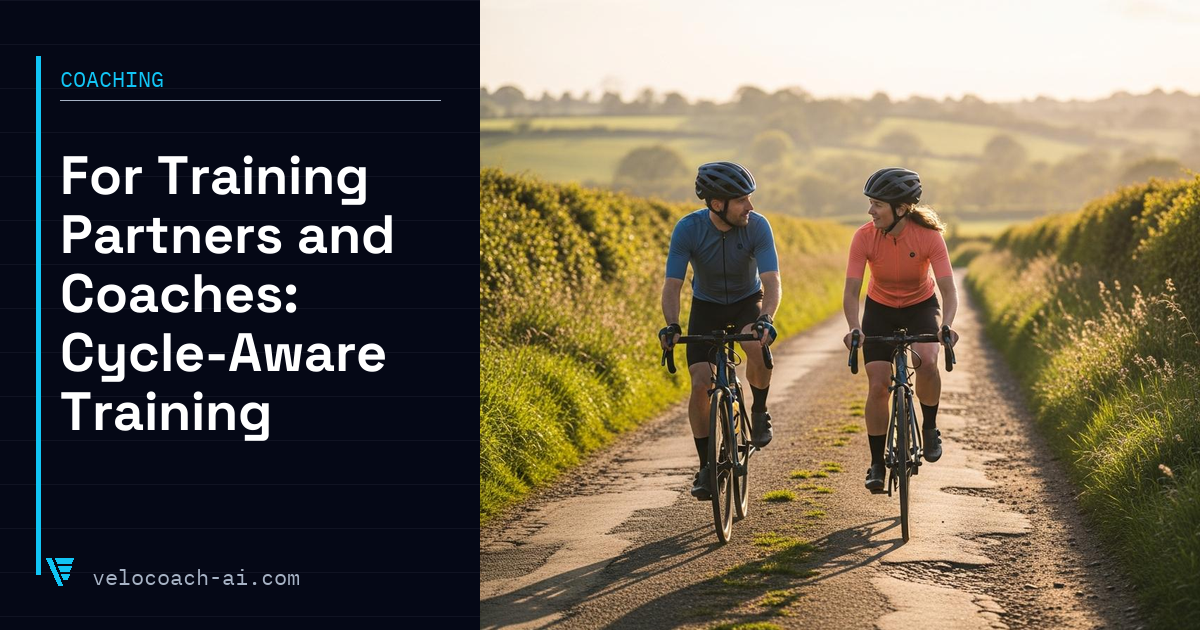
For Training Partners and Coaches: What to Know About Cycle-Aware Training
If you train with, coach, or partner with someone who has a menstrual cycle, you are already part of how cycle-aware training works. The athlete is doing the work of tracking and noticing. The performance team around her affects whether that work gets used well or gets used badly.
This piece is for you. It is short on hand-wringing and long on practical guidance. Read it once and you will be a better training partner or coach for it.
Why This Matters
Female cycling performance has been understudied for decades. Most coaching education programmes, including some of the most respected ones, taught training principles built almost entirely on male physiology. Female athletes adapted by figuring it out themselves, often without much support from their performance teams.
That gap is closing slowly. The 2025 historical review by Anthony Hackney and colleagues in the Scandinavian Journal of Medicine & Science in Sports described the cumulative effect of 40 years of male-default research as producing a "complex and inconsistent picture" of female athletic physiology that we are only beginning to clarify.
Your part in closing that gap is small but real. The athlete who feels supported in tracking and discussing her cycle does so. The athlete who picks up subtle cues that the conversation is unwelcome stops mentioning it, and you lose access to relevant context.
The Things You Don't Need to Become an Expert In
You don't need to memorise the four phases of the cycle, the hormonal interactions, or the relevant performance research. The athlete you train with knows her own body better than any textbook will tell you. Your job is not to coach her cycle; her job (or her sports dietitian's, or her medical team's) is.
Your job is to be informed enough to support the data she shares with you, to ask the right questions when something doesn't add up, and to not say the wrong thing.
The Things It Helps to Know
There are a few specifics worth understanding:
Cycle effects on performance are individual, not universal. The 2020 meta-analysis by Kelly McNulty and colleagues in Sports Medicine analysed 78 studies and found that group-level performance effects of cycle phase are trivial. Individual variation, however, is significant. Some athletes have a hard luteal phase. Some don't. Some perform their best during their period. Some don't. Treating cycle phase as a universal predictor of how today's session will go is wrong. The research is covered in detail here.
The luteal phase produces some real physiological changes. Core body temperature rises by roughly 0.5 degrees C. Ventilation rate increases. Heart rate can be higher at the same workload. In hot conditions or during long efforts, these can matter. They do not automatically mean a worse session.
Iron status matters and gets overlooked. Female endurance athletes are at substantially elevated risk of low iron, due to menstrual loss combined with exercise-induced reduction in iron absorption. If your training partner mentions fatigue that doesn't resolve, the right response is "have you had your ferritin checked recently" not "you probably need a rest day."
Relative Energy Deficiency in Sport (REDs) is common and dangerous. The 2023 IOC consensus statement estimated that 36 to 58 per cent of female endurance athletes show symptoms of REDs or low energy availability. Missing periods, slower recovery, increased illness, or unintentional weight loss are signals to take seriously, not to wave off.
What Not to Say
A handful of low-effort moves cost almost nothing and prevent the most common own-goals:
Do not joke about her "time of the month." Whether the joke is friendly or not, it tells her you are looking for that explanation rather than her actual data.
Don't pre-empt her training decision based on the calendar. If you want to be useful, ask "what does your data say today" instead of offering an out. Her plan is hers, her data tells the story, and she will make the call.
Do not assume a heavier or lighter session is needed based on the calendar. Her training plan is hers. Her decisions are hers. Your job is to support the plan she is following, not to revise it from the outside.
Do not talk about it loudly in front of others without her invitation. This should be obvious but isn't always.
Do not bring it up at all if she hasn't. If she wants to discuss it, she will. If she doesn't, your role is to ride alongside her at the pace she sets.
What To Say Instead
If she mentions feeling off in a particular phase, the right responses are: - "What's the pattern been over the last few cycles?" - "Is there anything in your data that backs that up?" - "Do you want to adjust today, or push through and see?"
These respect her data and her decision-making. They also work for any athlete in any context, which is part of why they're the right responses.
If she is consistently fatigued across cycles, the right order is to rule out iron, REDs, and thyroid issues before adjusting training. Any good coach would already do this. A GP and a sports dietitian are the first stops, not a deload week.
If You Are a Coach Specifically
A few additional principles for coaches:
Ask about cycle status when you first work with an athlete. Not in detail. Just enough to know whether she tracks her cycle, whether she has any known patterns, and whether she has a regular cycle at all (an absent or highly irregular cycle in a training athlete is itself a piece of clinical information).
Do not adjust training plans pre-emptively based on phase. The research does not support this. Adjust based on what you observe in her data and what she reports.
Educate yourself on REDs and iron. These are the two areas where coach knowledge matters most. If you cannot articulate REDs warning signs and iron testing recommendations, your education on female athlete physiology is incomplete.
Encourage cycle tracking, but as a data tool, not a planning tool. The point is to learn her individual pattern, not to impose a prescriptive plan from a calendar.
Be the person she can talk to about this if she wants to. Or, if you're not, make sure she has someone else in her support team who is.
The Bottom Line
You don't have to become a hormonal physiology expert to be a good training partner or coach for a female cyclist. You have to know enough to not get in the way, and you have to be the kind of person she can mention her cycle to without it becoming awkward.
Related Reading
- Training With Your Cycle: What the Research Actually Says
- Fuelling the Four Phases: Nutrition and the Menstrual Cycle
- HRV for Cyclists: What It Tells You and What It Doesn't
- Sleep and Cycling Performance
- Overtraining: Signs, Causes and Recovery
- Periodisation for Amateur Cyclists
Train with a coach that reads your data
VeloCoach AI connects to Garmin, Wahoo, Intervals.icu and Apple Health, and tells you exactly what to do next.
Download on the App Store