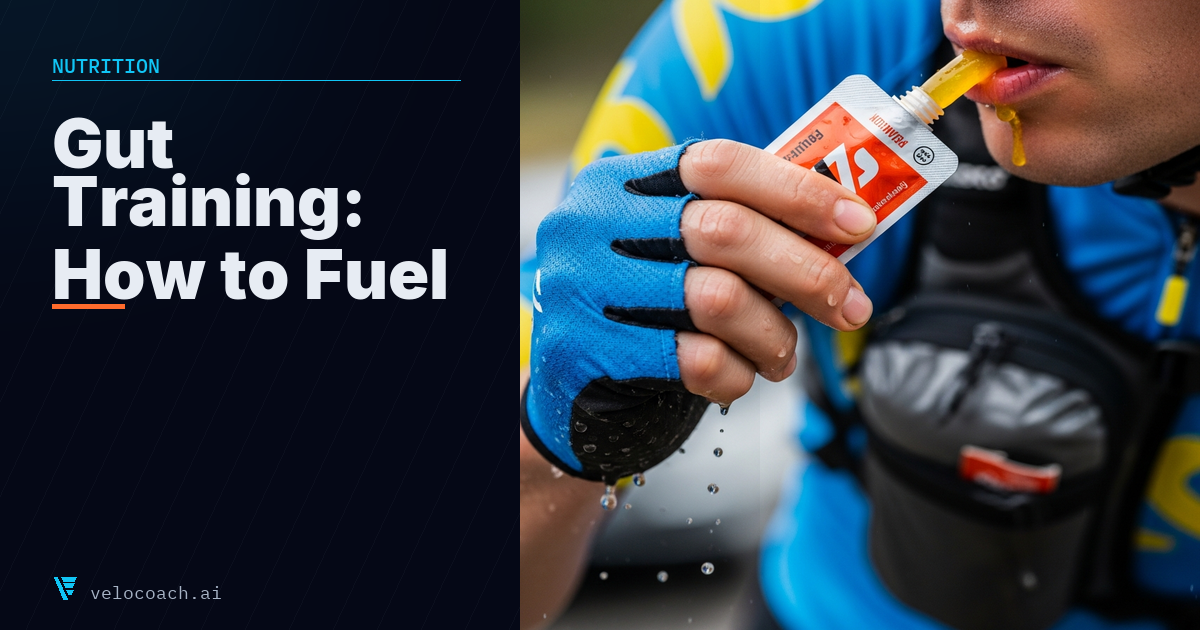
How to Train Your Gut to Handle 100g of Carbs Per Hour
For years, the sports nutrition consensus was clear: the human gut can absorb approximately 60 grams of carbohydrates per hour. Push beyond that and you get GI distress, nausea, and potentially a very undignified roadside stop.
Tour de France riders are now routinely consuming 120 grams of carbs per hour on race days. The science has moved on considerably, and the practical implications for any cyclist doing events over two hours are significant.
Here is what changed, why it matters, and how to train your gut to handle the new numbers.
Why 60g/Hour Was the Old Ceiling
The 60g limit comes from the saturation point of SGLT1, the intestinal transporter responsible for absorbing glucose. This transporter can only move so much glucose across the gut wall per hour. Once it is saturated, additional glucose stays in the gut, draws water in via osmosis, and causes the familiar bloating, cramping, and loose stool that distance athletes dread.
The breakthrough came when researchers studied multiple-transportable carbohydrates. Fructose uses a completely different transporter (GLUT5) and is therefore not competing with glucose for absorption. Combine glucose and fructose in the right ratio, and you can run both transporters simultaneously.
The optimal ratio is approximately 2:1, glucose to fructose. At this ratio, studies from the University of Birmingham and others showed that athletes could absorb up to 90 grams of carbohydrates per hour without significant GI issues. More recent protocols using maltodextrin and fructose combinations have pushed this to 120g/hour in well-trained gut athletes.
Why This Matters for Performance
The limitation in long cycling events is almost never cardiovascular. You can train your heart and lungs to deliver oxygen almost indefinitely. The limitation is energetic: muscle glycogen is finite, and when it runs out, performance collapses.
A rider consuming 60g of carbs per hour is sustaining approximately 240 calories from carbohydrate sources per hour. At 90g/hour, that becomes 360 calories. At 120g/hour, 480 calories. The difference is meaningful over four, five, or six hours. Better fuelling directly delays glycogen depletion, sustaining power output through the final third of a long race when competitors are running on fumes.
A narrative review published in 2025 in Sports Medicine examined the high-carbohydrate fuelling revolution in professional cycling. The finding was not that 100g/hour uniformly improves performance across all athletes, but that for events lasting three hours or more, the upper end of carbohydrate intake capacity is closely correlated with sustained power in the final hour.
The athletes who are performing best in late-race situations are typically the ones who have trained their guts to absorb the highest amounts of carbohydrate efficiently.
Why Your Gut Needs Training
The absorptive capacity of the gut is trainable. Regular exposure to high carbohydrate intakes during training causes adaptations in the gut:
- GLUT5 (the fructose transporter) upregulates with regular fructose consumption, increasing absorption capacity
- Gastric emptying rate improves with consistent training, moving fuel from stomach to small intestine faster
- General GI tolerance improves through conditioning, much like how running on tired legs gets less painful with practice
An athlete who has never consumed more than 60g/hour during training will almost certainly experience GI distress if they attempt 100g/hour on race day. The gut has not been prepared. The transporters are not upregulated. The stomach is not accustomed to the load.
This is why the professional approach to race day nutrition is not just a diet strategy. It is a training programme with specific protocols and a progression timeline.
The 6-Week Gut Training Protocol
The approach is progressive loading, in the same way you would progressively overload a training block on the bike.
Weeks 1-2: Establish the baseline Ride with 60g of carbs per hour (a mixture of glucose-based drinks and fructose-containing gels or bars, aiming for a 2:1 ratio). Take in something every 20-30 minutes rather than large boluses. Note any GI symptoms.
Common sources: energy drinks providing maltodextrin or glucose, combined with gels containing fructose. Products designed specifically for high-carb protocols (from brands like SIS, Maurten, or Precision Fuel) already contain the right ratio.
Weeks 3-4: Increase to 75-80g/hour Add one additional gel or increase the drink concentration. Pay attention to timing. GI issues in this phase often come from taking in too much at once rather than too much in total. Small, frequent intakes are more effective than large doses every 45 minutes.
Weeks 5-6: Target 90-100g/hour Your gut should now be adapted enough to handle the increase. Rotate sources to avoid flavour fatigue and reduce the risk of any single food becoming aversive (a real risk in long events when one gel format eventually becomes repellent).
Practice this on your longer training rides, particularly rides of two hours or more. Your race-day nutrition strategy is not the place to experiment for the first time.
Practical Product Guide
Not all carbohydrate sources are equal for high-rate fuelling:
Energy drinks should contain maltodextrin or glucose as the primary carbohydrate, not pure sucrose. Most commercial sports drinks are suitable.
Gels should contain fructose as well as glucose or maltodextrin. Check the label. Many cheaper gels are glucose-only and will limit your total absorption capacity regardless of how many you consume.
Real food options (bananas, dates, rice cakes) contain a natural mix of sugars and are perfectly viable for the 60-80g/hour range. Above 80g/hour, the sheer volume of solid food required makes gels and drinks more practical.
Avoid high-fat and high-fibre foods during rides. Both slow gastric emptying significantly and compete with carbohydrate absorption.
The Sodium Component
High carbohydrate fuelling is most effective when sodium intake is also elevated. Sodium drives fluid absorption and supports carbohydrate transport. At 100g/hour intakes, aim for 500-1000mg of sodium per hour from drinks, gels, or electrolyte tabs alongside your carbohydrate sources.
Dehydration and poor fuelling interact to compound performance decrements. Getting the hydration and sodium strategy right alongside the carbohydrate strategy is part of the same system.
---
Train with a coach that reads your data
VeloCoach AI connects to Garmin, Wahoo, Intervals.icu and Apple Health, and tells you exactly what to do next.
Download on the App Store