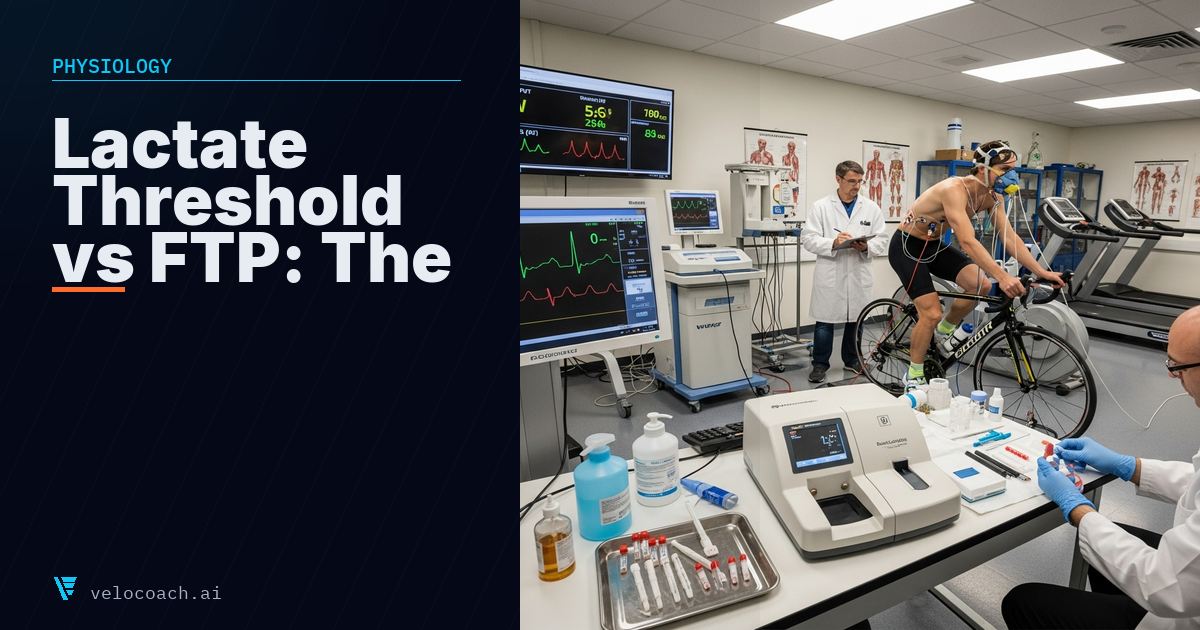
Lactate Threshold vs FTP: The Actual Difference
If you have spent any time reading about cycling training, you have encountered both "lactate threshold" and "FTP" used as though they are interchangeable. Sometimes they roughly are. Often they are not. The distinction matters because each concept describes something slightly different about your physiology, and confusing them leads to imprecise training prescriptions.
What Lactate Threshold Actually Means
Lactate threshold is a physiological measurement, not a mathematical formula. It refers to the exercise intensity at which blood lactate concentration begins to rise above resting levels in a systematic, sustained way.
In practice, there are two distinct thresholds:
LT1 (first lactate threshold, or aerobic threshold): The exercise intensity at which blood lactate first begins to rise measurably above baseline. Below LT1, the body produces very little lactate and clears it easily. Above LT1, lactate starts accumulating but at a manageable rate. This threshold typically sits at approximately 60 to 75% of VO2 max, and broadly corresponds to Zone 2 training.
LT2 (second lactate threshold, or lactate turn point): The exercise intensity above which lactate accumulation accelerates rapidly and cannot be cleared at the rate it is being produced. This is the "real" lactate threshold in common coaching usage. Sustaining exercise above LT2 leads to exponentially rising lactate and eventual fatigue. LT2 typically sits at approximately 80 to 90% of VO2 max.
Measuring lactate thresholds requires blood lactate testing: taking fingertip blood samples at multiple exercise intensities during a progressive test, plotting lactate concentration against power, and identifying the inflection points. This is the gold standard method used in sports science laboratories and by some elite cycling coaches.
What FTP Is and How It Relates
FTP (Functional Threshold Power) is a practical proxy for LT2. The concept was developed partly because blood lactate testing is expensive, invasive, and requires laboratory access. FTP provides an estimate of the power output corresponding to LT2 using only a power meter and a performance test.
The operational definition: FTP is the highest power output you can sustain for approximately 60 minutes. This corresponds closely, but not perfectly, to LT2 for most athletes.
The 2025 research from the University of Colorado confirmed this relationship: FTP closely correlates with LT2 in trained cyclists, and the correlation is strongest in well-trained athletes with consistent training histories. In less trained athletes, or those with high anaerobic capacity, the relationship is less reliable.
Where FTP and LT2 Diverge
For most trained cyclists, FTP is a reasonable approximation of LT2. But specific athlete profiles create divergence:
High anaerobic capacity athletes (sprinters, criterium racers): Their ability to sustain power above LT2 using anaerobic systems means a 20-minute or 40-minute power test captures a higher proportion of anaerobic contribution than for a purer aerobic athlete. Their measured FTP often sits above their true LT2.
Very aerobic athletes (trained endurance athletes): Their LT2 may be higher relative to VO2 max than typical, meaning FTP testing may actually underestimate their true LT2 if they pace the test conservatively.
Athletes with irregular training histories: Without consistent power data, estimating FTP from testing becomes less reliable. A block of illness or time off training changes the relationship between tested power and actual physiological threshold.
Why This Matters for Training
If your training zones are built on FTP and your actual LT2 is substantially different from your FTP, your zones are imprecise. Cyclists with inflated FTP (common in high-anaerobic athletes) are effectively training in higher zones than prescribed. Their "Zone 2" is actually Zone 3. Their "Zone 4" is actually Zone 5.
The practical consequence: their aerobic base training is not as easy as it should be, leading to under-recovery. Their quality sessions are harder than prescribed, also leading to under-recovery. The athlete is consistently training in slightly higher zones than intended without knowing it.
Getting LT2 Tested
For athletes serious enough to care about the distinction, a lactate test is worth doing once. Many sports science labs at universities offer testing for modest fees. Some coaching services offer field lactate testing.
What the test provides: - Accurate LT1 (aerobic threshold) to calibrate Zone 2 training - Accurate LT2 to calibrate threshold training zones - A lactate power curve that shows how your metabolism responds to increasing intensity
If laboratory testing is not accessible, the ramp test (as used by TrainerRoad and others) provides a more reliable FTP estimate for most athletes than the 20-minute test, and reduces the overestimation bias in high-anaerobic-capacity cyclists.
Working With the Relationship
The practical takeaway: FTP is a useful working number for most cyclists. Use it confidently for training zone calculation, knowing it is an approximation of LT2 that works well for the majority of trained athletes.
If your training responses consistently do not match expectations (threshold sessions feel harder or easier than they should, Zone 2 feels like more than easy, performance does not improve with correct zone training), consider either a ramp test to recalibrate FTP or, for the most precision, a laboratory lactate test.
---
Train with a coach that reads your data
VeloCoach AI connects to Garmin, Wahoo, Intervals.icu and Apple Health, and tells you exactly what to do next.
Download on the App Store