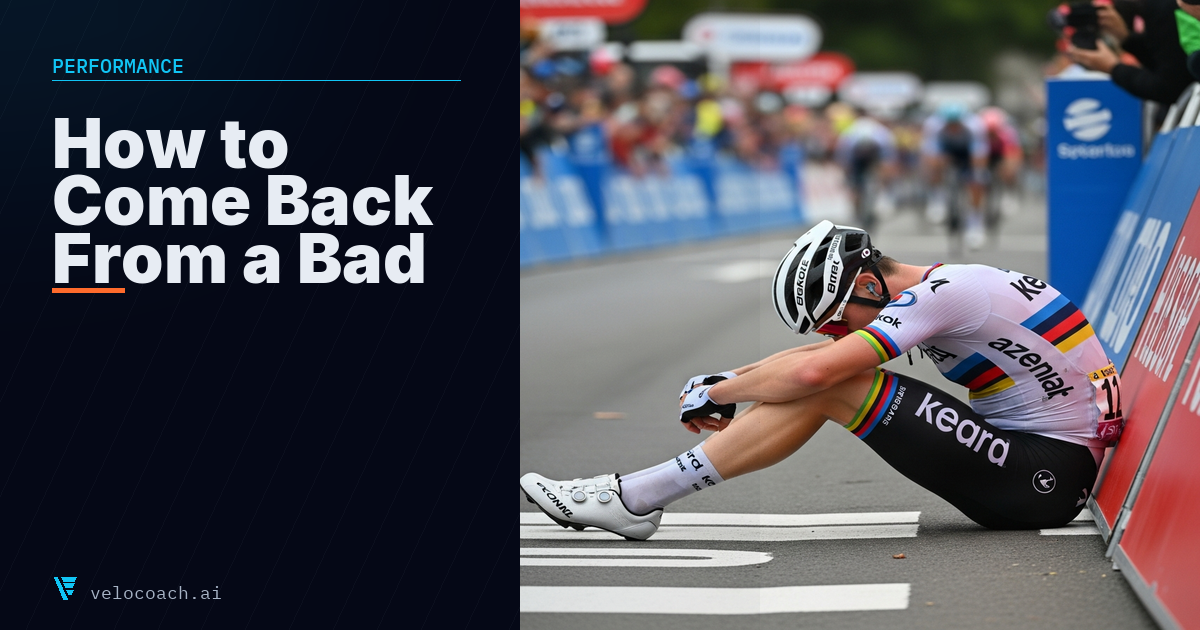
How to Come Back From a Bad Race
Every cyclist has them: the sportive you trained for all winter that fell apart in the rain. The criterium where you were dropped before the first prime. The time trial where your legs simply were not there. The gran fondo where you bonked 30km from the finish.
How you respond to a bad result matters more than the result itself. The difference between cyclists who use disappointing performances productively and those who are derailed by them is not talent, and it is not temperament. It is a set of learnable cognitive and practical responses.
First: Separate the Emotional from the Analytical
In the hours and days after a poor performance, two separate processes need to happen, and mixing them undermines both.
The emotional process: Allow yourself to feel disappointed. Minimising a genuine disappointment ("it doesn't matter, it's just a race") is not psychological resilience; it is avoidance that tends to resurface as motivation problems later. If the race mattered, the disappointment is proportional. Acknowledge it, talk about it if you need to, and give yourself a day or two before trying to extract lessons.
The analytical process: Once the emotional intensity has dropped (usually 48 to 72 hours after a bad performance), the data and the experience become useful information rather than sources of pain. This is when post-race analysis is productive.
Trying to analyse a race immediately while emotionally activated typically produces conclusions distorted by the emotional state: excessive self-criticism, false lessons drawn from a non-representative event, or defensive rationalisations that prevent genuine learning.
Use the Data Before Constructing a Narrative
Pull up the ride file and look at the actual numbers before deciding what happened. The story you tell yourself about a bad race is often inaccurate, and data provides a corrective.
Common narrative vs data mismatches:
"I just gave up" vs the data shows power consistent throughout. What you experienced as "giving up" was actually reaching your limit and the effort ceiling dropping. You did not give up; you maxed out. The response is different (training to raise the ceiling) than the narrative implies (willpower training).
"I was dropped because I'm too slow" vs the data shows you went 20% above FTP in the first five minutes. You were dropped because of pacing error, not insufficient fitness. The lesson is tactical, not physiological.
"Everything was wrong" vs the data shows a good first half followed by a collapse. This is often a fuelling failure, dehydration issue, or a specific mechanical or tactical problem at the collapse point.
Read the data first. Then construct the post-race narrative.
Identify One or Two Controllable Lessons
The most useful post-race learning is specific and actionable. "I need to get fitter" is not useful. "My fuelling failed in the third hour and my power dropped 15% from kilometre 90 onward" is useful. "I couldn't respond to attacks in the final climb" is useful and points to a specific training priority.
From any bad race, extract one to two specific, controllable lessons: - A tactical error you can address with race experience and planning - A physiological limiter the data clearly identifies (durability, sprint power, climbing W/kg) - A logistical or preparation failure (nutrition, equipment, warm-up, sleep the night before)
Then write these down and keep them. Before your next comparable event, review them.
Avoid Overgeneralising
One bad race at a specific distance, in specific conditions, after a specific training block does not tell you much about your general ability. It tells you about that race, those conditions, that day.
Be careful about the conclusions you draw from a single data point. A bad TT in the rain after a high-volume training week says something specific about your performance under those conditions. It does not say something definitive about your TT ability in general.
Similarly, avoid comparing the bad performance to the good ones in a way that erases the context of each. A peak performance happened under peak conditions (optimal taper, good day, motivating atmosphere, correct fuelling). A poor performance happened under different conditions. The variance between your best and worst days includes a large component that is not within your control.
The Recovery Question: What Does This Tell Me About My Training?
If a bad performance has a clear physiological cause (not tactical, not logistical), the most productive response is adjusting training priorities.
Dropped on climbs throughout: W/kg needs to improve. Either FTP needs to rise, weight needs to fall, or both. Review your climbing-specific training and consider whether sufficient time has been spent on climb-specific efforts and building sustainable aerobic power relative to body weight.
Faded badly in the final hour: Durability is the issue. Increase long-ride volume, include prolonged sweet spot work at the end of long rides, and ensure pre-event glycogen loading and race-day fuelling are optimal.
Couldn't hold on during repeated attacks: Anaerobic capacity and repeatability are the issue. More VO2 max intervals with insufficient recovery between repetitions, or criterium-style efforts with multiple short maximal efforts.
General poor performance without an obvious physiological pattern: This often indicates accumulated fatigue going into the event. Review your pre-event taper (was it long enough? was Form positive?), your sleep in the preceding week, and whether any illness or life stress was undermining your capacity.
Managing the Training Aftermath
After a hard race (even a bad one), the body has been stressed. Treat the first week post-race as recovery regardless of how the race went. A bad performance does not mean you did not work hard; it often means you worked hard under suboptimal conditions.
Do not jump back into hard training immediately out of frustration. "I performed badly, so I need to train harder now" is an understandable emotional response and a physiologically poor decision.
Allow a week of reduced load before resuming structured training. Let HRV and resting heart rate return to baseline. Then, informed by the race's lessons, begin the next training block with clear priorities.
The Long Game Perspective
At the scale of a full training season, a single bad race has almost no effect on your long-term development. The cyclists who progress most over years are not the ones who never have bad races. They are the ones who have bad races, learn specific things from them, and show up to the next training week with slightly better information about what they need to work on.
A bad race is data. The investment is not wasted. The preparation, the travel, the effort, the discomfort, all of it provided information about your current state that you could not have gotten any other way.
---
Train with a coach that reads your data
VeloCoach AI connects to Garmin, Wahoo, Intervals.icu and Apple Health, and tells you exactly what to do next.
Download on the App Store