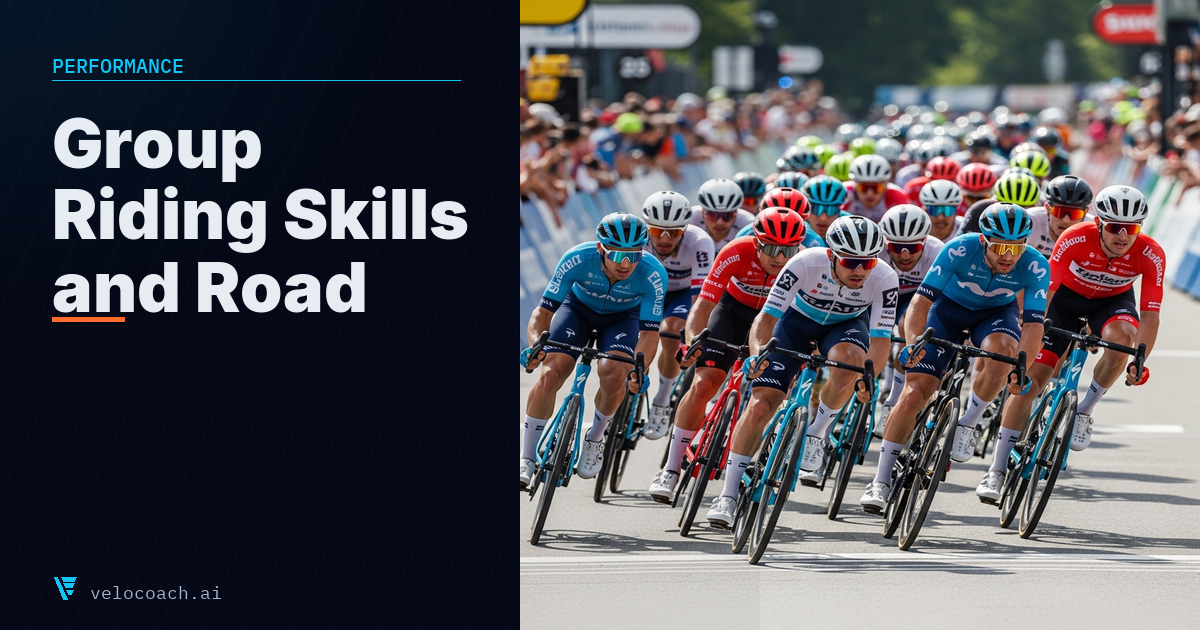
Group Riding Skills and Road Race Tactics
Riding in a group is a fundamentally different skill set from solo cycling. The aerodynamic and physiological benefits of riding in a bunch are enormous, but they require specific techniques and tactical awareness to exploit. For cyclists who have trained predominantly alone or on an indoor trainer, joining a fast group ride or entering a road race for the first time often reveals a significant skills gap.
The Aerodynamic Reality of Drafting
The power savings from drafting are larger than most cyclists realise. A rider sitting directly behind another cyclist in a well-positioned draft typically saves 25 to 35% of the power required to maintain the same speed in the open air. In a large bunch, riders deeper in the group may save 40% or more.
This translates to: a cyclist who needs 250W to ride solo at 35 km/h might sustain the same speed in a tight draft for 160 to 175W. Over a 4-hour ride, this difference compounds into an enormous energy saving.
The catch: to access this benefit, you need to be close enough to the wheel ahead to be in the aerodynamic shadow (roughly within one wheel length) without making contact. This requires concentration, smooth bike handling, and trust in your own braking reflexes.
Following a Wheel
The skill of following a wheel closely is learnable but requires practice. The key technical elements:
Focus on the rider in front, not their wheel. Watching the wheel directly in front of you gives minimal reaction time to changes of pace. Watching the rider ahead, and peripherally monitoring their wheel, gives you earlier signals of speed changes and allows smoother responses.
Brake as little as possible. Experienced bunch riders rarely touch their brakes in a moving group at steady pace. Speed changes are managed primarily by adjusting pedal pressure (soft pedalling or briefly sitting up to increase drag). Braking in a group creates accordion effects that propagate backward through the bunch and can cause crashes.
Ride smoothly. Surges and sharp deceleration from a rider near the front cascade backward through the bunch. Contributing to this effect makes you unpopular and unsafe. Smooth, progressive changes of pace are the mark of an experienced group rider.
Predict, do not react. Watch for signals that the pace is about to change: a rider sitting up, a junction approaching, a hill beginning. Anticipate the change and begin adjusting before it arrives rather than reacting to it.
Rotating Turns and Sharing the Work
In a cooperative bunch (a sportive, a chain gang training ride, or a road race breakaway), sharing the work at the front maintains group speed while distributing effort evenly. The standard rotation:
Double paceline (chain gang): Two parallel lines, one moving faster than the other. The right-hand line (upwind line in crosswind) rotates to the front, then the rider peels off into the left-hand line (downwind line) and drifts toward the rear. Each rider takes a consistent duration at the front (typically 30 seconds to 2 minutes depending on pace and conditions).
Single paceline: Riders move to the front one at a time, take a short pull, and peel off to one side, drifting to the rear.
Etiquette: take turns proportional to your ability. A weaker rider taking shorter pulls is acceptable. Not taking turns while strong enough to is not. Sitting at the front but not actually pulling (blocking) is a tactical move in races but inappropriate in training groups.
Race Tactics: Road Race Basics
A road race is tactically more complex than a group training ride. Several concepts are worth understanding before your first race.
Position matters enormously. Riding near the front of the bunch is safer and requires less effort per unit of speed than riding at the back. A rider at the back of a 50-person bunch experiences significantly more accordion effect (surges and braking that don't reflect the actual speed of the front of the bunch) and uses more energy managing these oscillations.
Attacks and responses. When a rider attacks (accelerates sharply out of the bunch), the correct immediate response for anyone who wants to follow is to match the acceleration immediately, not after a pause. A one-second hesitation in responding to an attack creates a gap that is far harder to close than simply matching the initial acceleration. The first few riders who follow are part of the break; everyone else is chasing.
Economy before the finish. In a race expected to end in a bunch sprint, the final 20 to 30 kilometres are not the time to be working hard at the front. Get into the bunch, conserve energy, and manage your position carefully as the race approaches the finish.
Read the race. Where are the strong riders? Who is working hard? Where are the likely attack points (bottom of climbs, crosswinds, the start of the final straight)? Active awareness of the race situation allows you to respond before the critical moment rather than reacting to it.
Cornering in a Group
Cornering with other riders is where accidents most commonly occur. Key principles:
Brake before the corner, not through it. Any braking mid-corner risks the rear wheel sliding. All speed reduction should happen in a straight line before the entry to the bend.
Take the same line as the riders ahead. Do not try to cut a corner tighter than the rider in front. The predictability of your line matters as much as the quality of your line in a group.
Do not overlap wheels. If your front wheel overlaps the rear wheel of the rider ahead and they move sideways even slightly, you will crash. Maintain space so that any lateral movement of the rider ahead does not touch your wheel.
Communicate. Calling "easy" when slowing, "hole" when pointing out road hazards, and "stopping" when braking hard are simple group communications that significantly improve safety.
Starting Point: The Club Ride
The most accessible route into group riding is a local club ride. Most cycling clubs offer rides at multiple paces, and the slower chain gang rides are excellent learning environments: speeds are manageable, riders are experienced, and there is tolerance for beginners developing their skills.
Turning up to your first club ride and explaining that you are new to group riding will almost always be met helpfully. Experienced riders understand that these skills take time and are usually willing to guide a new rider on handling and etiquette.
---
Train with a coach that reads your data
VeloCoach AI connects to Garmin, Wahoo, Intervals.icu and Apple Health, and tells you exactly what to do next.
Download on the App Store