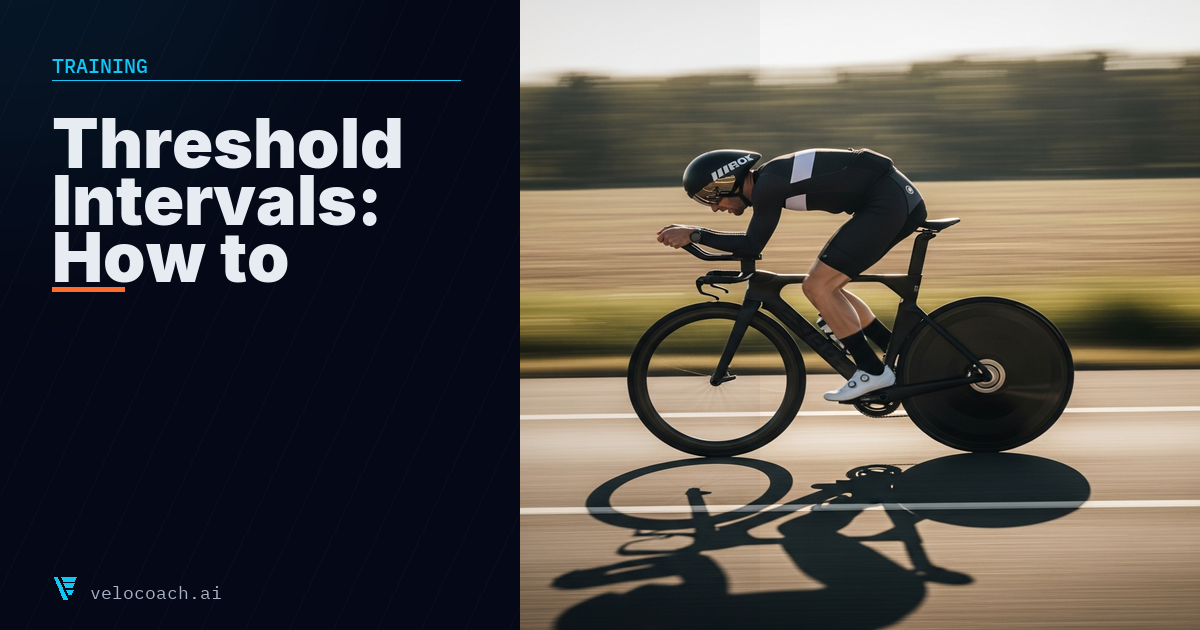
Threshold Intervals: The Definitive Guide
Threshold training is the session most cyclists do, argue about, fear, and fail to execute correctly in roughly equal measure. Done well, it is one of the most effective training stimuli available. Done badly, it produces fatigue without the corresponding adaptation.
The problem is rarely the concept. It is the execution. Here is exactly what threshold training is, what it does, and how to do it properly.
What Threshold Training Is
FTP (Functional Threshold Power) represents the highest power output you can sustain for approximately 60 minutes. Threshold training targets this intensity zone, typically 91 to 105% of FTP.
At threshold intensity, you are working at the upper boundary of your aerobic capacity. Lactate production and clearance are roughly matched. The effort is hard but sustainable for meaningful durations. You can speak in short sentences but not hold a full conversation. Heart rate climbs to approximately 85-95% of maximum.
The adaptations from threshold training include increased lactate threshold, improved cycling economy, higher cardiac output, and improved muscular efficiency at sustained high power. These are the adaptations that directly translate to time trial performance, sportive power, and the ability to sustain hard efforts in races.
Why Most Threshold Sessions Are Executed Badly
The three most common errors:
Starting too hard. Threshold is "hard but sustainable" intensity. Many cyclists, particularly in group settings or when feeling good, start 5-10% above target power and pay for it dramatically in the final third of the interval. A good threshold session finishes as strong as it started, or stronger. If your power drops by more than 5% in the final quarter of an interval, you went out too hard.
Training too close to failure. Threshold intervals should be hard and demanding, but they should not leave you unable to function for 48 hours afterwards. If a 2x20 session at FTP destroys you for two days, either your FTP is set too high or you need to build to this volume more gradually.
Doing it when too fatigued. Threshold training on deeply negative Form produces poor-quality intervals and accumulates fatigue without producing the adaptation quality you are after. Quality sessions require adequate freshness.
The Main Threshold Session Formats
2x20 minutes at FTP (100%) The gold standard threshold session. Twenty minutes of work at exactly your FTP power, 5 minutes easy recovery, repeat. This format is demanding but produces maximum adaptation at threshold. Start with 2x15 if you have not trained at this intensity before and build over four to six weeks.
3x15 minutes at 95-100% FTP Slightly more manageable per interval but equivalent total quality. The shorter intervals allow slightly better quality maintenance and are a useful progression between lower-intensity work and full 20-minute efforts.
4x10 minutes at 100-105% FTP Higher intensity, shorter duration. Targets the top of the threshold zone and produces a stronger VO2 max stimulus alongside the threshold adaptation. Demanding recovery cost.
1x40-60 minutes at 90-95% FTP Sustained sub-maximal threshold work that better mirrors race conditions for time trials and breakaways. Less mentally demanding per-minute than the shorter interval formats, but requires significant mental resolve to maintain for the duration.
Micro-intervals: 10 minutes at 95% FTP with 30-second surges to 120% every 3 minutes Race-specific format that trains the ability to respond to accelerations while sustaining threshold effort. Highly effective for criterium and road race preparation.
How to Structure a Threshold Training Block
Threshold training works best in blocks of 4 to 8 weeks where volume progressively increases:
Week 1: 2x15 minutes at FTP, twice per week Week 2: 2x20 minutes at FTP, twice per week Week 3: 3x15 minutes at FTP, twice per week Week 4: 3x20 minutes at FTP, twice per week (this is a significant week, allow extra recovery) Week 5-6: Maintain volume, add intensity variations (10-minute efforts at 102-105%) Week 7-8: Reduce volume to recovery, peak with a key test or race
A common mistake is trying to maintain maximum threshold volume year-round. Threshold training is demanding enough that it requires genuine recovery periods. After a 6-8 week block, shift to a different training emphasis (VO2 max, base, or race prep) before returning to another threshold block.
Recovery Between Sessions
Threshold sessions require 48 hours of quality recovery before the next hard session. A schedule that places two threshold sessions per week should separate them by at least two days, with a genuine Zone 2 or rest day between.
The recovery day after a threshold session is not a day to squeeze in extra easy volume. It is a day for active recovery (Zone 1 riding at very low intensity or complete rest) to allow the adaptation from the session to consolidate.
Athletes who push through threshold sessions on inadequate recovery accumulate fatigue without the corresponding adaptation. The session happened. The adaptation did not.
Reading Your Data During Threshold Intervals
Power should be stable within 3-5% of target throughout the interval. A well-paced 20-minute effort at 250W should see you riding at 245-255W for the full 20 minutes, not starting at 270W and fading to 230W.
Heart rate during threshold work rises progressively throughout the interval (cardiac drift). A well-conditioned athlete might see heart rate at 85% of maximum at the start of a 20-minute interval and 92% at the finish. If heart rate is at maximum in the first five minutes, the power is too high.
RPE at the end of a properly executed threshold interval should be approximately 7-8 out of 10. Hard, demanding, uncomfortable. Not 10 out of 10.
---
Train with a coach that reads your data
VeloCoach AI connects to Garmin, Wahoo, Intervals.icu and Apple Health, and tells you exactly what to do next.
Download on the App Store