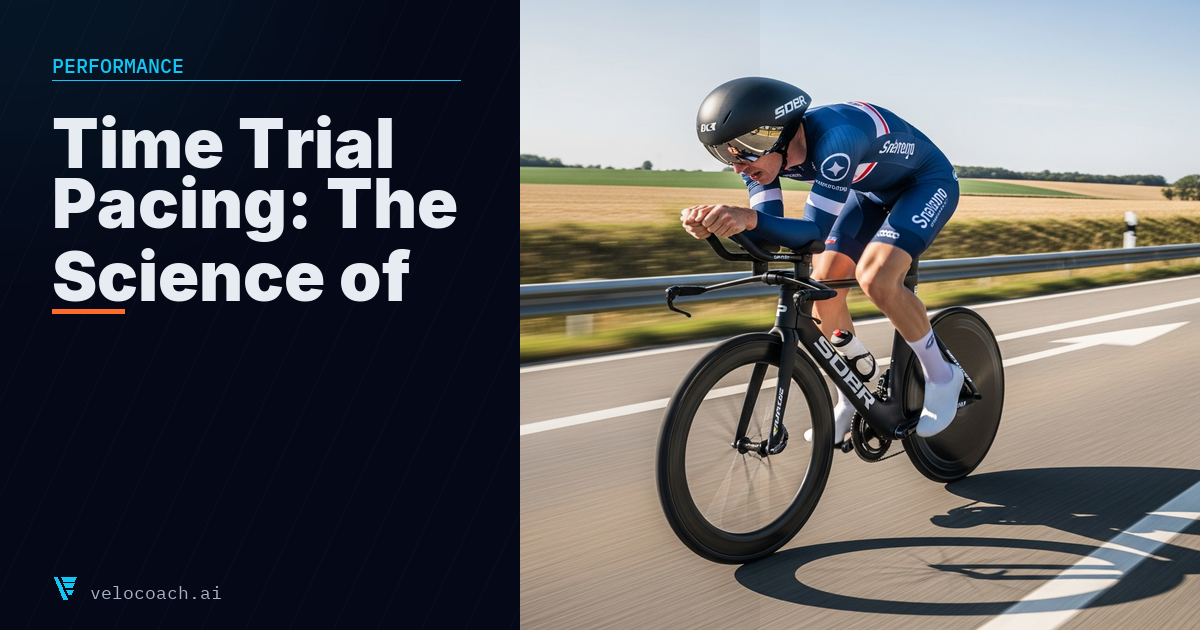
Time Trial Pacing: The Science of Getting It Right
The time trial is the purest test in cycling. No drafting, no tactics, no one to hide behind. Your power output, your pacing, and your ability to sustain effort over a defined distance are the only variables. And yet the pacing errors in amateur time trials are remarkably consistent: riders go too hard at the start, pay for it in the second half, and lose far more time than the initial pace advantage ever generated.
Getting pacing right in a time trial is not about willpower or experience alone. It is about understanding the physiological consequences of going too hard too early and knowing how to use power data to prevent the most common and costly mistakes.
The Physiology of Pacing
At threshold and above, the body relies on a blend of aerobic and anaerobic energy systems. Anaerobic contribution increases rapidly as intensity rises above FTP, and this contribution comes at a cost: the accumulation of metabolic by-products (particularly hydrogen ions) that progressively impair muscle contractile function.
Going 5% above your target power in the first quarter of a time trial is not recoverable by riding 5% below target later. The accumulated metabolic fatigue from the early overshoot continues to suppress your capacity for the remainder of the effort, meaning the "saved" time at the start costs disproportionately more time later.
This is why truly negative splits (riding faster in the second half than the first) or near-even splits are physiologically optimal for efforts of 20 minutes or longer. The race against the metabolic clock is won by starting the metabolic expenditure rate at a level you can sustain, not by starting fast and hoping to hang on.
Even Pacing vs Positive vs Negative
For most amateur time trialists, even pacing (consistent power throughout) is the practical target. The research on optimal pacing strategy for TTs of 20 to 60 minutes is clear:
Even pacing: Optimal for flat courses, moderate weather conditions, familiar power profile. Aim for power variation within ±5% of target throughout the effort.
Variable pacing (course-adjusted): On hilly courses, optimal power distribution changes. The aerodynamic and speed relationship with terrain means you should put out higher power on climbs and lower power on descents than on flats to achieve optimal time. Not simply ride at consistent power. Use a power meter to target effort rather than speed.
Positive split (fast start): Commonly seen in amateur TTs, consistently suboptimal. Riders who go 10 to 15% above target power in the first quarter almost always finish slower overall than those who pace evenly.
Negative split: Optimal in theory (starting below target and building) but psychologically difficult and requires very accurate self-knowledge. In practice, many cyclists who intend to negative split simply start conservatively and never build to target power. A slight negative split of 2 to 5% (first half slightly below target, second half slightly above) is achievable and beneficial.
Setting Your Target Power
The starting point for time trial pacing is your FTP. For a 20-minute TT, sustainable power is approximately 105 to 110% of FTP. For a 40km TT (roughly 60 minutes for most club-level cyclists), sustainable power is 95 to 102% of FTP. For a 10-mile TT (roughly 20 to 25 minutes for most riders), approximately 105% of FTP.
These are starting estimates. Individual durability matters enormously: an athlete with excellent durability (flat power curve from 20 to 60 minutes) can sustain closer to FTP for 60 minutes than an athlete whose power drops off more steeply with duration. Review your power curve to understand where your 60-minute power sits relative to your 20-minute power.
If your FTP is based on a 20-minute test, note that the 20-minute-test-derived FTP (power multiplied by 0.95) may be optimistic for your actual 60-minute sustainable power. Use a conservative estimate for your first few time trials and refine from data.
Managing the Start
The start of a time trial is the highest-risk moment for pacing error. Fresh legs, adrenaline, a crowd (if applicable), and the desire to "bank time" all conspire to push you above target power.
A practical protocol for the first three minutes: - Ride the first 60 seconds at 90% of target power - Build to target power over the next 90 seconds - At 2.5 to 3 minutes, settle at target power
This is physiologically wise: it allows the aerobic system to become fully engaged before you are riding at the effort level that requires complete aerobic commitment. It also prevents the early metabolic overshoot that compromises the second half.
If power data shows you are over target in the first 5 minutes, ease off immediately, even if it feels conservative. The time cost of being 5% over in the first 5 minutes will exceed the time saved, and the metabolic cost will be felt for the remainder of the effort.
Cadence and Wind
In headwinds, reduce speed (let wind slow you) rather than increasing power. The power cost of riding through a headwind is already higher; adding more power on top does not produce proportional speed gains at the most aerodynamically demanding part of the effort.
In tailwinds, maintain target power and enjoy the speed benefit. The temptation to soft-pedal in tailwinds and "save" for headwind sections misses the physics: time in tailwind is already fast, so additional power here gives more time benefit per watt than riding harder into a headwind.
Cadence preference varies individually, but for most cyclists, a slightly higher cadence (90 to 100 rpm) in the early stages of a time trial reduces muscular fatigue accumulation relative to a lower cadence (80 to 85 rpm) at the same power. As fatigue accumulates, cadence naturally drops; starting slightly above your preferred cadence gives you room to drop to it naturally rather than forcing a low cadence throughout.
After the Event: Data Analysis
The most useful post-TT analysis is your power distribution by quarter. A well-paced event looks like four roughly equal average power values. A poorly paced event shows high power in the first quarter, declining across the effort. Identifying the magnitude and timing of your pacing error gives you a specific correction target for the next event.
Also compare your FTP-relative power to the estimate above. If your 40km TT power was only 88% of FTP, either your FTP is overstated or your durability is limiting your performance in longer efforts.
---
Train with a coach that reads your data
VeloCoach AI connects to Garmin, Wahoo, Intervals.icu and Apple Health, and tells you exactly what to do next.
Download on the App Store