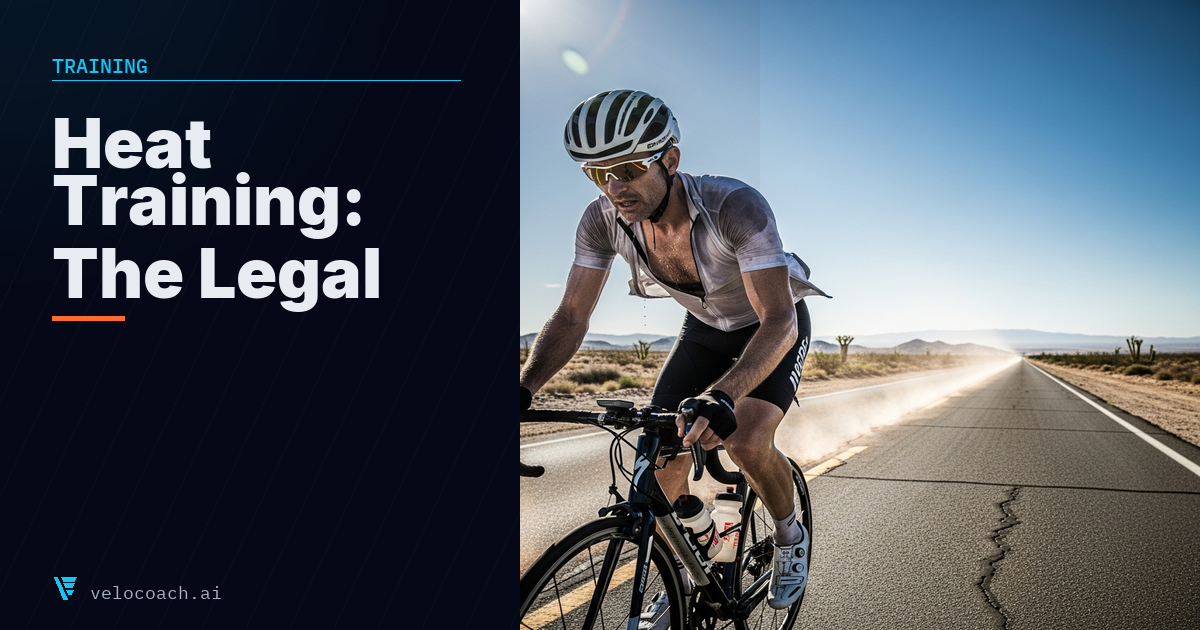
Heat Training: The Altitude Alternative You Can Do at Home
Altitude training has been a cornerstone of elite endurance sport preparation for decades. The principle is well-established: at altitude, reduced oxygen partial pressure stimulates red blood cell production and increases haemoglobin mass. More haemoglobin means more oxygen-carrying capacity. More oxygen-carrying capacity means improved endurance performance.
The problem is altitude camps are expensive, disruptive, and not available to most athletes. Three weeks at a high-altitude training centre in Tenerife, Font Romeu, or Colorado is an option for professional teams with significant budgets. For the rest of us, it has historically not been a practical consideration.
That is changing. Research published over the last five years has consistently shown that heat training can produce comparable increases in haemoglobin mass without leaving sea level, and some of it can be done at home with access to nothing more than a sauna or a warm room.
The Physiology: Why Heat Works
Heat stress and altitude stress share an important physiological pathway. Both create a state of reduced oxygen availability in the tissues, though through different mechanisms. At altitude, oxygen partial pressure is lower. In heat, blood is redirected toward the skin for cooling, reducing delivery to working muscles.
The body's response to both stresses includes increasing the production of erythropoietin (EPO), the hormone that drives red blood cell production. More EPO means more red blood cells and more haemoglobin, which is exactly the adaptation you are after.
Haemoglobin mass (Hbmass) is one of the strongest predictors of endurance performance in cyclists. A 1% increase in Hbmass is associated with roughly a 1% improvement in VO2 max, which in turn predicts performance in time trials and climbing events.
What the Research Shows
A study published in the Journal of Applied Physiology in late 2025 tracked well-trained endurance athletes completing heat training alongside a moderate-altitude camp. The combination produced significantly greater Hbmass gains than altitude alone, a finding that confirms heat training as an additive intervention rather than simply a weaker substitute.
Earlier landmark research comparing five weeks of heat training (six sessions of 60 minutes per week in a hot environment) against three weeks of live-high-train-high altitude exposure found similar increases in Hbmass between the two approaches. The 2025 study in the Journal of Physiology confirmed that when haemoglobin mass is the primary outcome measure, heat training competes directly with altitude.
Professional teams including Lotto Dstny have incorporated heat training protocols into their standard preparation calendar. This is not experimental fringe practice. It is mainstream, evidence-based performance preparation with a growing body of literature.
How Much Heat Training Is Needed
Research protocols have consistently used five to six weeks of heat training with three to six sessions per week. Session duration is typically 45 to 60 minutes in the heat. The heat exposure can come from:
- Post-ride sauna sessions (most practical and most studied)
- Training in a heated room or tent (30°C or above)
- Hot baths immediately after training
The post-ride sauna protocol is the most practically accessible. A 20 to 30-minute sauna session (temperature 80-100°C in a traditional Finnish sauna) immediately following a training session produces the required thermal stress with minimal interference to the training itself.
An important consideration: the heat stress works by elevating core temperature and creating plasma volume expansion as an initial adaptation, followed by Hbmass gains over the following weeks. Core temperature elevation of 1-1.5°C is the target stimulus. This is achievable in a sauna or hot bath. It is not achievable through simply wearing extra layers during training, which primarily makes you sweat more without the same core temperature response.
The Practical Protocol
Who benefits: Heat training produces the clearest performance returns for athletes with a solid training base who are looking for an additional stimulus. It is not a substitute for structured training. Think of it as adding 5 to 10% on top of a well-designed programme, not as a shortcut around one.
Timing in the season: Best used in the 6 to 10 weeks before a key event, giving the Hbmass adaptations time to develop. The gains persist for approximately three to four weeks after ending heat exposure, so timing the end of the heat training block relative to race day matters.
Weekly protocol: - 4 to 6 sessions per week - Each session: 20 to 30 minutes sauna post-ride, or 45 to 60 minutes exercising in a 30-35°C environment - Maintain hydration aggressively. Heat training significantly increases fluid and electrolyte demands. - Do not combine heat exposure with very high training intensity. The combined stress of heat and hard training is significant and increases injury and illness risk.
Hydration: Drink 500-750ml of water or electrolyte drink before your sauna session. Continue hydrating after. Plasma volume expansion (one of the first adaptations to heat training) requires adequate fluid intake to develop fully. Arriving dehydrated at each session blunts the adaptation.
What to Expect
The initial adaptation within the first two weeks is plasma volume expansion. You may notice that your resting heart rate drops slightly and your power at a given heart rate improves. These early changes are encouraging but are not yet the full haemoglobin adaptation.
The Hbmass gains follow over weeks three to six, and the full performance benefit typically appears after the training block ends, when both the haemoglobin gains and the reduction in fatigue from the heat stress combine.
Modest but consistent performance gains: typically 1 to 3% improvement in VO2 max and time-trial performance. Not dramatic, but for athletes who have been training consistently for several years and have fewer easy gains remaining, 2% is meaningful.
Limitations
Heat training is not appropriate for everyone. Athletes with cardiovascular risk factors should consult a physician before starting. The heat stress is physiologically significant and requires appropriate health status to tolerate.
The performance gains are also real but small. Heat training is not a replacement for the fitness adaptations that come from years of consistent, structured training. It supplements those adaptations at the margin.
---
Train with a coach that reads your data
VeloCoach AI connects to Garmin, Wahoo, Intervals.icu and Apple Health, and tells you exactly what to do next.
Download on the App Store