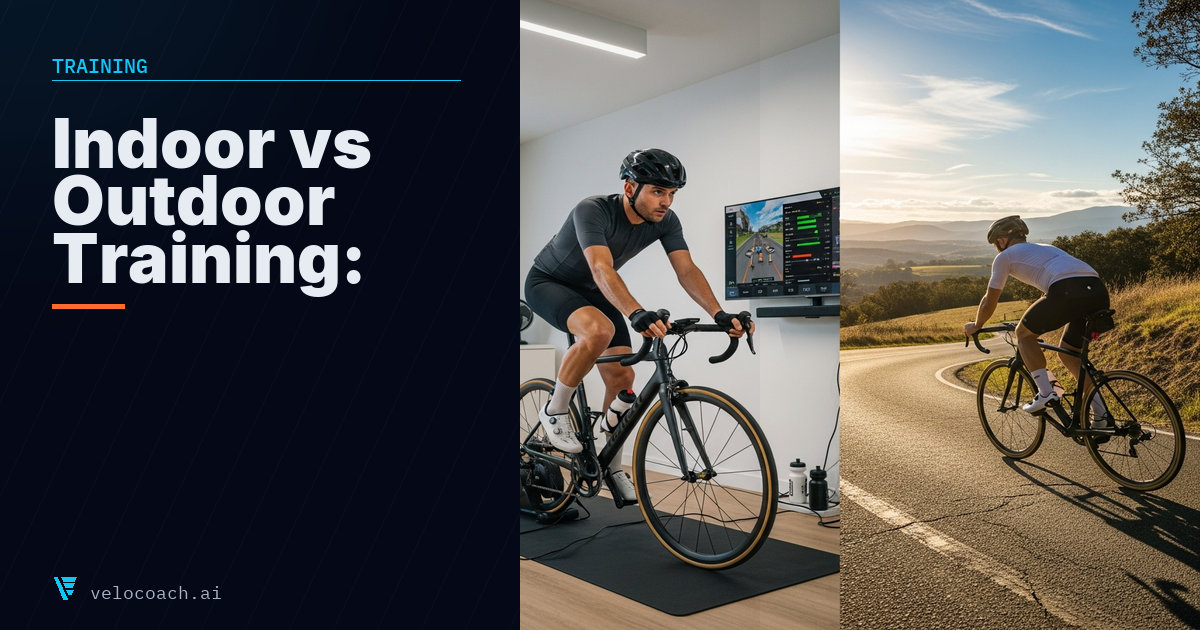
Indoor vs Outdoor Training: When Each Is Best and Why
The debate about indoor versus outdoor training used to be simple: indoor was a necessary evil for winter months, outdoor was always preferable when conditions allowed. Smart trainers and virtual platforms have complicated that narrative significantly.
Neither environment is universally superior. Each has genuine advantages that make it the better choice in specific situations. Understanding which is which lets you design a training programme that uses both intelligently.
The Case for Indoor Training
Precision. Indoor training with a smart trainer gives you complete control over power output with no variables. A 20-minute threshold interval at 250W is exactly that, without traffic, wind, descents, or traffic lights interrupting the stimulus. For interval work that requires sustained power precision, the indoor environment is genuinely superior.
Research on training specificity suggests that the quality of interval execution matters significantly. An outdoor threshold session on a hilly route with three traffic light stops and a downhill section in the middle produces less training stimulus per hour than a clean indoor session. For high-intensity work, the controlled environment is an advantage, not a limitation.
Efficiency. An hour of quality indoor training often produces more training stress than a comparable outdoor ride. There is no coasting, no soft-pedalling in a group, no easing off on descents. If time is your constraining resource, indoor training is more time-efficient for producing training stress.
Controllability. Weather, darkness, traffic, and road surface are irrelevant indoors. For athletes with limited flexible time windows, the ability to start a session reliably regardless of conditions is significant. January at 6am is not compatible with most outdoor training for most of the year in the UK.
Safety. Interval training at high intensity requires concentration. Doing VO2 max efforts on a busy road involves divided attention that compromises both training quality and safety. Indoor training allows full concentration on the effort.
The Case for Outdoor Training
Neuromuscular specificity. Outdoor cycling requires constant small adjustments: responding to terrain changes, navigating corners, reacting to group movements. These neuromuscular demands keep the nervous system engaged in ways that smooth, steady-state indoor training does not. For cyclists who race or do events with varied terrain, some outdoor training is not optional.
Bike handling skill. Cornering, descending, group positioning, and reading road surfaces are skills that deteriorate with disuse and cannot be maintained indoors. Athletes who train exclusively indoors over winter often return to outdoor riding with noticeably reduced technical confidence.
Training that matches the event. A 100-mile sportive with 2,000m of climbing cannot be fully prepared for on a trainer. The sustained outdoor endurance demands, the positional comfort over five or six hours, and the mental engagement required for very long rides are best prepared through actual long outdoor rides.
Mental recovery. For many athletes, outdoor riding provides a psychological benefit that indoor training cannot match. Being outside, moving through terrain, riding with other people: these contribute to motivation and mental wellbeing in ways that affect training consistency over months. Motivation is a performance variable. Burning out on the trainer in February has consequences for April's training.
Terrain-specific preparation. If your A race is a mountain sportive, riding real hills builds specific muscular and psychological preparation that virtual climbing cannot replicate.
A Practical Framework
For quality interval work: Favour indoor training. Threshold, VO2 max, sweet spot, and neuromuscular efforts all execute better on a trainer where power is consistent and uninterrupted.
For long aerobic endurance: Favour outdoor riding, particularly for rides over two hours. The variety, terrain engagement, and mental stimulation of outdoor riding makes long Zone 2 riding more sustainable and more enjoyable, which matters enormously for compliance over a training year.
For year-round training in the UK: Build indoor capability for November to February interval work. Maintain outdoor long rides as weather allows. Return predominantly outdoor as spring arrives.
For high-stress life periods: Indoor training is often more compatible with irregular schedules. Short, high-quality indoor sessions can replace longer outdoor rides when time is limited.
The Smart Trainer Ecosystem
The quality of indoor training has improved dramatically with smart trainers. The main platforms (Zwift, TrainerRoad, Wahoo SYSTM) each offer different training approaches worth understanding.
Zwift is primarily a community and racing platform. The training plans are basic but the social element is strong. For motivation and group riding simulation, it is the leading option.
TrainerRoad offers the most structured training plans with the strongest AI adaptation. For pure performance-focused interval training, it remains the most developed platform.
Wahoo SYSTM uses the 4DP profile (four-dimensional power: neuromuscular power, maximal aerobic power, FTP, and anaerobic capacity) to tailor sessions to individual power profiles. Worth considering if the single-number FTP model feels inadequate for your profile.
The choice of platform matters less than the consistency of use. An athlete who does structured indoor intervals twice a week for 20 weeks will improve significantly regardless of which platform they use.
---
Train with a coach that reads your data
VeloCoach AI connects to Garmin, Wahoo, Intervals.icu and Apple Health, and tells you exactly what to do next.
Download on the App Store